NVIDIA GPUs accelerate Sintavia aerospace heat exchanger design
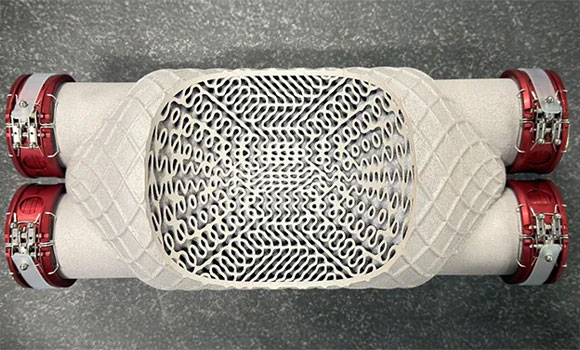
Sintavia’s additively manufactured heat exchanger core, fabricated as a single-piece unibody for aerospace applications (Courtesy Sintavia/NVIDIA)

NVIDIA, headquartered in Santa Clara, California, USA, has published a case study focused on how aerospace component manufacturer Sintavia, based in Hollywood, Florida, has used GPU-accelerated simulation workflows to develop lightweight heat exchangers for aerospace and defence applications.
According to the report, Sintavia used NVIDIA’s RTX PRO 6000 Blackwell Workstation Edition GPUs in its high-performance workstations and NVIDIA data centre GPUs within its high-performance computing (HPC) clusters to support simulation-driven design. The study noted that the NVIDIA hardware was used alongside CUDA-enabled engineering software from nTop and Siemens, including Siemens’ Simcenter STAR-CCM+.

“Before, we were constrained by compute. Large simulations could take days – even weeks,” stated Jose Troitino, Principal Design Engineer at Sintavia. “With NVIDIA Blackwell GPUs, we have cut runtimes dramatically and scaled to models we never thought possible.”

The NVIDIA RTX PRO 6000 Blackwell Workstation Edition GPU includes 96 GB of GDDR7 memory and 24,064 CUDA cores, enabling simulations that previously
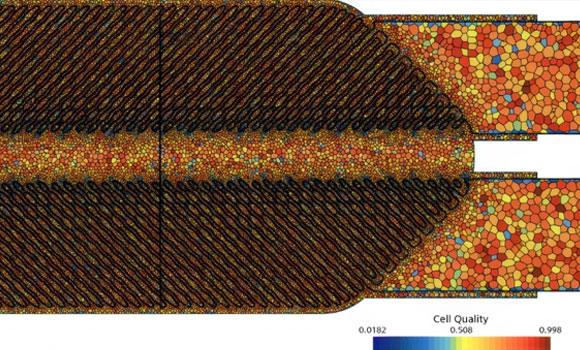
Sintavia used nTop to create a heat exchanger mesh with over 30 million elements, optimised for the RTX PRO 6000 Blackwell GPU, using 82.6 GB of the full 96 GB of RAM (Courtesy NVIDIA)

As part of the case study, NVIDIA highlighted a recent project in which Sintavia developed a next-generation heat exchanger for an aerospace customer within two weeks using GPU-accelerated simulation.

The report stated that GPU computing delivered more than eleven times faster results than CPU-based workflows for Simcenter STAR-CCM+ workloads.
Article: Inside Nikon’s metal AM strategy
Part 2: Scaling industrial production in Long Beach
Read now

In Sintavia’s internal testing, it was reported that a 30 million-cell conjugate heat transfer simulation with more than 300 iterations ran in approximately seven minutes on a Blackwell GPU, compared with eighty-eight minutes on a 24-core AMD 7965WX CPU.

The heat exchanger was additively manufactured as a single component. According to the case study, the design achieved approximately 30% weight reduction and a 20% improvement in thermal efficiency compared to conventional designs.

Sintavia reported that the component’s integrity was validated through in-house computed tomography (CT) inspection and downstream thermal and flow testing.
nvidia.com

sintavia.com

GET THIS ISSUE:  PDF  |  VIEW ONLINE  |  BUYER’S GUIDE

TRUSTED CONTENT. TARGETED AUDIENCE

Advertise with Metal AM and access a global base of 50,000+ AM professionals.

Contact Jon Craxford: [email protected]

Request a Media Pack
  • AM machines
  • Process monitoring & calibration
  • Heat treatment & sintering
  • HIP systems & services
  • Pre- & post-processing technology
  • Powders, powder production and analysis
  • Part manufacturers
  • Consulting, training & market data

Don’t miss a thing – register for our newsletter

Don't miss any new issue of Metal AM magazine, and get the latest industry news. Sign up to our twice weekly newsletter.

Register now

Join 40,000+ other AM professionals – follow us online

About Metal Additive Manufacturing magazine

Metal AM magazine, published quarterly in digital and print formats, is read by a rapidly expanding international audience.

Our audience includes component manufacturers, end-users, materials and equipment suppliers, analysts, researchers and more.

In addition to providing extensive industry news coverage, Metal AM magazine is known for exclusive, in-depth articles and technical reports.

Our focus is the entire metal AM process from design to application.

Each issue is available as an easy-to-navigate digital edition and a high-quality print publication.

Discover our magazine archive…

The free to access Metal Additive Manufacturing magazine archive offers unparalleled insight into the world of metal Additive Manufacturing from a commercial and technological perspective through:

  • Reports on visits to leading metal AM part manufacturers and industry suppliers
  • Articles on technology and application trends
  • Information on materials developments
  • Reviews of key technical presentations from the international conference circuit
  • International industry news

All past issues are available to download as free PDFs or view in your browser.

Browse the archive

Share via
Copy link
Powered by Social Snap