NAMIC partnerships in defence, industry and tech sectors

At the 14th Global Additive Manufacturing Summit (GAMS), which took place October 16 to 17 in Singapore, the National Additive Manufacturing Innovation Cluster (NAMIC) signed a number of strategic partnerships with the aim of strengthening local capabilities, accelerating industry adoption, and expanding talent development in Additive Manufacturing.

“As NAMIC marks its 10th year since inception, we’ve seen Additive Manufacturing evolve from rapid prototyping into a strategic enabler of innovation and sustainable industrialisation,” stated Dr Ho Chaw Sing, Chief Executive Officer of NAMIC. “Our mission is to help enterprises integrate additive-based technologies into manufacturing workflows as one of the core pillars in business transformation, upskilling our talent, enabling sustainability, and strengthening Singapore’s position as a global hub in advanced manufacturing.”
Now in its 14th edition, GAMS 2025 ran alongside ITAP 2025 under the theme Unlocking Agility and Scale with Digitalisation and Additive Manufacturing. Attracting over 750 delegates, the event covered topics such as supply-chain resilience, scalable production, AI-enabled workflows, and sustainable manufacturing.
During the event, NAMIC announced the following strategic agreements:
Strengthening supply chain resilience through the adoption of AM
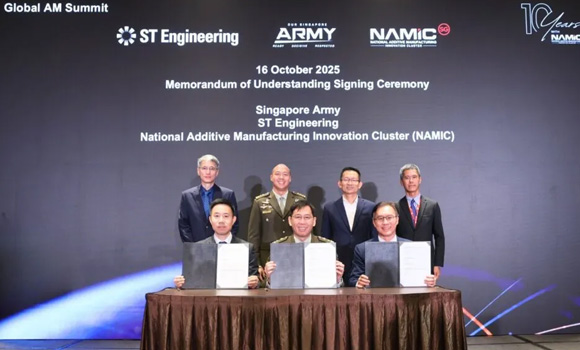
A Memoranda of Understanding (MoU), between NAMIC, Singapore Army and ST Engineering’s Land Systems, aims to advance operational agility and strengthen supply chain resilience through the adoption of AM and the development of digital inventories. The collaboration aims to enhance Singapore’s maintenance, repair and overhaul (MRO) capabilities, while building a workforce equipped with certified AM skills and expertise to support large-scale adoption.
Traditional spare parts supply chains face challenges such as long lead times, high inventory holding costs, and vulnerability to global disruptions. This tripartite partnership looks to create a digital repository of parts that can be additively manufactured on demand near the point of need by the end-user or manufacturer. The collaboration aims to develop and scale AM technologies and digital inventories for operational deployment. The partnership will also involve the certifying and upskilling of AM professionals through the National AM Jobs-Skills Accreditation Framework (NAAF).
“This partnership establishes a strong innovation nexus between defence, research, and industry to further common AM interests, and creates a pathway from cutting-edge development to industrial applications,” said Commander, Combat Service Support Command (CSSCOM) ME8 Tan Mu Yen. “By harnessing the transformative potential of Additive Manufacturing to bolster our supply chain resilience, we will also enhance the readiness of our Army’s assets. This will also provide an opportunity for our people to build competencies in this critical emerging technology.”
Roger Lim, Senior Vice President and Head of Additive Manufacturing, Land Systems, ST Engineering, added “ST Engineering has been leveraging Additive Manufacturing in our maintenance, repair and overhaul operations to accelerate the design-to-print cycle, strengthen supply chain resilience and deliver innovative solutions. This collaboration with the Singapore Army and NAMIC will not only benefit the broader ecosystem, but also deepen our competencies, enabling us to enhance maintenance turnaround times and ensure the operational readiness of mission-critical assets.”
The collaboration will also develop standards and certifications to enable the deployment of emerging AM technologies, alongside exploring ways within the local AM ecosystem to be more cost-competitive against conventional manufacturing methods.
Dr Ho Chaw Sing stated, “Building on our longstanding collaboration with the Singapore Army and ST Engineering, NAMIC is committed to bolstering supply chain resilience through the development of digital inventory asset libraries, developing our AM talent pool and standards, bolstering Singapore’s defence readiness, technological leadership, and industrial competitiveness.”
Collectively, these efforts are expected to enhance the operational agility and resilience of the Singapore Army, strengthen the MRO capabilities and industry competitiveness, while fostering sustainable growth for the AM ecosystem in Singapore.
Binder Jetting for the tooling, automotive, and medical sectors
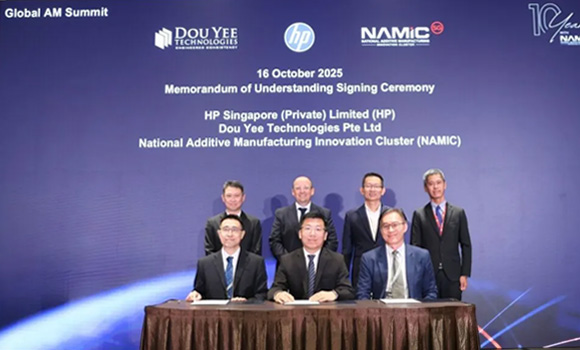
Secondly, NAMIC, HP Inc, and Dou Yee Technologies, signed a MoU to collaborate on advancing the commercial adoption of metal Binder Jetting (BJT) for industrial applications, targeting the tooling, automotive, and medical sectors.
“NAMIC is committed to strengthening Singapore’s advanced manufacturing ecosystem bolstering Singapore’s reputation as one of the leading global AM hubs. Working alongside HP and Dou Yee Technologies, we aim to help industry players adopt metal BJT more effectively and build the digital manufacturing capabilities of the future,” stated Dr Ho Chaw Sing.
The aim is to establish a robust development-to-production workflow for metal BJT applications. The partners will seek to accelerate qualification processes, define clear transition pathways to scaled manufacturing, and strengthen local manufacturing agility and resilience through digital production capabilities.
“HP Additive Manufacturing Solutions (HPAM) is committed to empowering the transformation of metal manufacturing through mass-production-ready solutions and end-to-end local ecosystem collaborations,” said Alex Moñino, SVP and GM of HPAM. “Singapore sits at the heart of Southeast Asia’s manufacturing ecosystem, making it an ideal location to introduce new technologies. With NAMIC’s strong research and application development hubs and Dou Yee Technologies’ deep expertise in Powder Metallurgy, we’re excited about this collaboration and the opportunities it brings to enable new applications and businesses across the APJ region.”
The partners will collaborate on industry pilots to demonstrate and qualify metal Binder Jetting for demanding applications. These efforts will focus on validating application performance against industry standards, helping local manufacturers adopt and scale up MBJ for production.
Tan See Cheong, VP (Operations) of Dou Yee Technologies, added, “At Dou Yee Technologies, we see strong potential in metal BJT to support our customers with high-mix, low-volume production, rapid turnaround without tooling, and the ability to manufacture high value-added products with intricate geometries. This collaboration aligns with our goal of enabling faster, more flexible manufacturing solutions for demanding industries.”
Scalable digital workflows for AM adoption in high-tech sectors

NAMIC, along with A*STAR Institute of Materials Research and Engineering (IMRE), LCFC Electronics Technology, and Hyperforge Holdings, also signed an MoU to jointly explore the deployment of advanced technologies spanning materials, design and manufacturing, to support LCFC’s innovation and digital transformation.
This partnership is seen a key milestone for LCFC, Lenovo’s manufacturing arm and a World Economic Forum Global Lighthouse Factory, in its Industry 5.0 strategy, to support data-driven and knowledge-based manufacturing with workforce augmentation technologies. By integrating AI-powered manufacturing solutions with advanced computational design and materials science, this MoU aligns with LCFC’s commitment to building flexible, data-driven production systems that deliver greater value to customers.
“As a leading R&D and manufacturing hub for intelligent computing devices, LCFC is committed to integrating emerging industrial technologies into production,” said Zhen Qin, Director of the AI Solutions Division of LCFC. “Our strengths are reflected in our highly automated production processes, deeply interconnected data-driven system, flexible and agile manufacturing capabilities, and commitment to green and sustainable development. This collaboration with Hyperforge, NAMIC, and IMRE will strengthen our competitiveness and resilience while driving innovation in product design and manufacturing. We will continue to expand the use of advanced technologies such as artificial intelligence and digital twins, explore new approaches to intelligent manufacturing, and work toward building a high-standard factory with global influence.”
This collaboration looks to bring together complementary strengths across the entire AM value chain (algorithmic and AI-assisted product design with large geometry models, rapid simulation, advanced materials development, and production-scale validation) to help manufacturers shorten development cycles, improve product performance and cost efficiency, and establish scalable digital workflows for AM adoption in high-tech sectors.
“Hyperforge provides differentiated, cross-disciplinary solutions for advanced manufacturing by combining innovative materials, algorithmic engineering, and next-generation design into a unified ecosystem,” stated Glen Tay, Chief Operating Officer of Hyperforge. “Through an integrated design–simulate–optimise loop, our solutions cut engineering cycles from weeks to hours, enabling rapid exploration of complex geometries, automated simulation-driven design, and faster transitions from design to production. We are privileged to collaborate with world-class institutions such as LCFC, NAMIC, and IMRE, combining our complementary strengths across the entire additive manufacturing value chain to accelerate this transformation.”
“The future of manufacturing is not just about printing parts; it is about printing performance,” added Prof Loh Xian Jun, Executive Director of A*STAR IMRE. “This collaboration places IMRE’s materials innovation at the core of the design process. By fusing our materials science with the algorithmic power of Hyperforge and the manufacturing scale of LCFC, we are creating a powerful, data-driven engine that shortens development cycles and delivers superior, cost-effective products to the global market.”
Together, LCFC, Hyperforge, IMRE, and NAMIC aim to demonstrate measurable reductions in design cycle time, enhance product performance and cost efficiency, and establish repeatable digital workflows that manufacturers can adopt to scale Additive Manufacturing.
“NAMIC has been at the forefront of bridging AM research and industrial applications, supporting enterprises in developing and integrating design and AM capabilities as part of the irrevocable shift towards digital and sustainable manufacturing. NAMIC is pleased to partner with Hyperforge and IMRE to support LCFC’s digital transformation journey in building capabilities to develop and manufacture best-in-class market-leading products,” said Dr Ho Chaw Sing.
Braille for young children
Additionally, to mark its 10th anniversary milestone, NAMIC introduced an additively manufactured braille book for young children with visual impairments. Developed with local partners Tusitala and iC2 PrepHouse, and supported by the DesignSingapore Council, the book combines braille text and raised illustrations to make storytelling more accessible for visually impaired children.
Singapore’s evolving AM landscape
NAMIC also released “The Future of Manufacturing with Additive Technology”, a report on Singapore’s evolving AM landscape, informed by an industry-led survey. Amid global supply-chain shifts, it highlights the need for Singapore-based enterprises to embrace design flexibility combined with on-demand production, which is realisable with AM adoption. It outlines the strategies needed to sharpen Singapore’s competitive edge, leveraging on strengths in key sectors such as aerospace, semiconductors and marine, while the need to stay nimble for other sectors such as defence, biomedical, space, and sustainability.