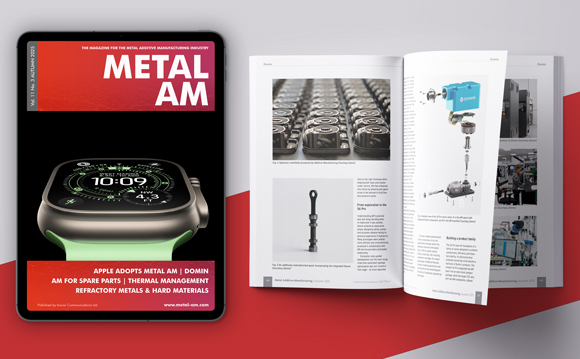
Metal Additive Manufacturing, Vol. 11 No. 3 Autumn 2025
Prefer a PDF download? Click here
In addition to the latest industry news, this 236-page issue of Metal Additive Manufacturing magazine includes the following exclusive features:
Doing more with less: Domin’s evidence-based path to Additive Manufacturing success using maraging steel
Additive Manufacturing’s promise isn’t in ‘printing everything’ – it is in knowing exactly where to apply the technology. At Domin, a UK manufacturer of motion control products, CEO Marcus Pont’s team uses the technology sparingly yet decisively, exploiting AM-enabled innovations and its potential to deliver complex internal geometries. The twist? A focus on steel. Too often overlooked for titanium or aluminium, maraging steel underpins robust, precise, and efficient hydraulic products.
Martin McMahon explores the disciplined use of AM as a powerful tool: performance first, costs controlled, and selectively delivering impact at scale.
| Get PDF | | | Read online |
Beyond the ‘digital warehouse’: What’s really driving the Additive Manufacturing of spare parts in 2025
The notion of a digital warehouse encapsulates the potential of cloud-based digital twins, produced locally and on demand by Additive Manufacturing. This approach promises increased efficiency, sustainability, and resilience against trade barriers and logistical disruptions. In the Winter 2021 edition of Metal AM, an initial survey established a baseline of practice in digital spare parts.
In this article, Joseph Kowen revisits that foundation, analysing subsequent developments, persistent challenges, and the evolving industrial and geopolitical factors influencing the adoption of additively manufactured spare parts.
| Get PDF | | | Read online |
Additive Manufacturing for spacecraft thermal management: Heat pipes, radiators, and the role of Shape Memory Alloys
As space missions push towards 100 kW nuclear fission systems and megawatt-class propulsion, thermal management is becoming a critical bottleneck. Backed by NASA programmes and working with 3D Systems, researchers at Penn State and Arizona State universities are leveraging metal AM to develop titanium radiator panels with integral heat pipes and NiTi components for self-deploying systems. Tests under simulated orbital conditions showed more than 50% performance gains, proving AM’s potential to cut mass and boost efficiency in spacecraft cooling
| Get PDF | | | Read online |
Additive Manufacturing at Plansee Seminar 2025: The rise of refractory metals and hard materials
At the 21st Plansee Seminar, it became clear that Additive Manufacturing has firmly established itself within the refractory metals and hard materials community. Presentations covered the full process spectrum – from powder handling and melt pool modelling to in-situ control and post-processing – with results directly relevant to industrial adoption.
As Bernard North reports, work on molybdenum, tungsten, rhenium and niobium highlighted practical paths toward dense, reliable components for energy, aerospace and nuclear fusion technologies, marking a decisive step from laboratory feasibility to engineered applications.
| Get PDF | | | Read online |
Tantalum without limits: Additive Manufacturing unlocks new medical and industrial applications
Tantalum offers a valuable combination of corrosion resistance, high melting point, and biocompatibility, but conventional processing is material‑intensive and slow. Croom Medical, in partnership with Global Advanced Metals (GAM), has developed TALOS, a PBF‑LB platform for pure tantalum that targets repeatable production with controlled powder quality and closed‑loop reuse.
This article reviews the manufacturing approach, early mechanical results relative to wrought, and practical design options such as porous lattices, internal channels, and titanium-tantalum hybrids, with implications for cost, supply, and performance in medical and industrial markets.
| Get PDF | | | Read online |
From specification to standard: SAE’s role in aerospace and Additive Manufacturing
To mark the tenth anniversary of SAE International’s Additive Manufacturing standards committee (AMS AM), Bill Bihlman, Committee Member of SAE AMS AM and Programme Director for Composites at Fraunhofer USA, traces the evolution of aerospace material standards and the role of consensus-based frameworks in supporting industrial-scale AM adoption.
From the early AMS documents of the 1930s to today’s challenges in certification, supply chain alignment, and MRO integration, the article highlights how SAE’s approach to standardisation continues to support maturing AM processes across diverse aerospace applications.
| Get PDF | | | Read online |
Transforming suppressor engineering with metal Additive Manufacturing
Metal Additive Manufacturing is reshaping suppressor production. Where conventional designs demanded dozens of machined parts, AM enables monolithic builds with optimised gas pathways, reduced weight, and minimal waste. This shift not only simplifies manufacturing, but also enhances reliability by eliminating tolerance stack issues.
As James Patterson explains, a century after Hiram Percy Maxim’s original silencer, the technology he pioneered is being redefined through AM, offering new levels of performance, efficiency, and design freedom in suppressor engineering.
| Get PDF | | | Read online |
< Back to archive