Heatflow and DTI develop compact AM heat exchanger for green methanol engines
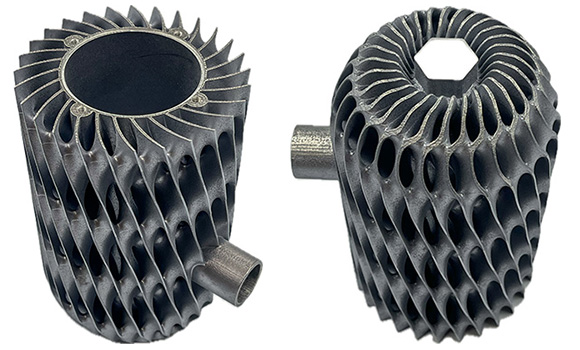
The Danish Technological Institute (DTI), located in Taastrup, has reported on a recent collaboration with Heatflow, based in Hobro, Denmark, to demonstrate the use of metal Additive Manufacturing to produce a gas-to-gas heat exchanger.
In progressing sustainable transportation, green methanol has emerged as a promising alternative fuel, particularly for heavy-duty applications like trucks and ships, explains the DTI. In northern Europe, however, the fuel has hit a significant adoption barrier: methanol engines won’t start in temperatures below 11ºC.
This limitation has created a geographical divide in green fuel adoption: while southern European regions can successfully implement methanol engines year-round, the technology remains inaccessible to northern markets.
Applying AM for compact performance
In a Mission Booster project funded by Innovation Fund Denmark, Heatflow, and DTI set out to develop a solution to this challenge: a compact, additively manufactured gas-to-gas heat exchanger that enables methanol engines to start reliably in sub-zero conditions.
The system works by incorporating a methanol burner that can operate at temperatures as low as -10°C. This burner preheats air through the specially designed heat exchanger, which in turn warms the engine sufficiently for reliable cold-weather starting.
“The 3D-printed heat exchanger reduced size and weight significantly and, after heat treatment, increased heat transfer efficiency by around 50%, which was key to achieving compact integration,” stated Paw V Mortensen, CEO at Heatflow ApS.
Heatflow had previously demonstrated the working principle of such a heating system, but the original design was prohibitively large for practical engine integration, which is why 3D printing was chosen for an optimised version of the system.
Simon Brudler, added, “3D printing is needed to make the system compact enough to actually pack into an engine. It is mainly about form factor: achieving the same performance in a much smaller space.”
This was achieved via the manufacture of complex internal geometries in sizes that may have been impossible to achieve with traditional manufacturing. Additive Manufacturing also enabled the creation of intricate gyroid structures and the rapid iteration of design.
“The project demonstrated that additive manufacturing enables a significantly more compact gas-to-gas heat exchanger, suitable for engine integration,” Mortensen added.

Gas-to-gas heat exchange
This project addressed a challenging application in the Additive Manufacturing world: gas-to-gas heat exchangers. While most AM heat exchangers in the industry focus on liquid-to-liquid applications, this project is intended to demonstrate the viability of AM technology for gas-based thermal management systems.
“We demonstrated the suitability of AM heat exchangers for gas-to-gas applications, highlighting how this opens doors for similar applications across various industries where gas-phase heat exchange is critical,” stated Ellen MJ Hedegaard, AM business manager at DTI.
The final working prototype was additively manufactured in aluminium to optimise weight while maintaining thermal performance. After manufacturing, the project also had help from DTI’s specialists within green energy systems, who conducted comprehensive performance testing, thus validating the system’s effectiveness in enabling cold-weather methanol engine operation.
While the project focused on heavy-duty applications, Heatflow has since identified clear potential for adapting the preheater technology to maritime systems, where similar cold-start challenges exist. This is expected to be explored in future development activities.
For Heatflow, the project delivered a validated proof-of-concept showing reliable cold-start functionality under lab conditions, confirming the technology’s potential for further scaling.
Mortensen added, “The collaboration with DTI was decisive. They combined design-for-AM expertise with practical testing, enabling us to move from concept to validated prototype in less than a year.”
In addition to Heatflow and DTI, Alicon was also a partner and contributed with system specifications and integration requirements.
Facts and future
The Mission Booster project resulted in a working prototype of the heat exchanger that was tested and verified in controlled environments. Next, Heatflow and DTI are exploring opportunities for further development through funded projects, as market demand for methanol engine solutions continues to grow.
Green methanol has relevance beyond Scandinavia. In China, for example, major automotive companies have been seeking solutions for methanol engine deployment in the colder northern regions.
“This solution removes a key barrier for methanol engines in cold regions. With proven performance at -20°C, it enables e-methanol to become a viable fuel in both heavy transport and shipping,” stated Paw V Mortensen.
According to the team, their combination of thermal management design and advanced Additive Manufacturing demonstrates how AM can solve specific, high-impact challenges in the green energy transition, turning promising sustainable technologies into practical, deployable solutions for cold-climate markets.