HBD enables metal AM production of lightweight titanium bike frames
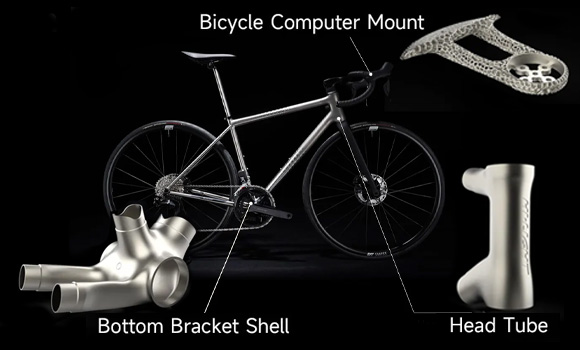
Shanghai Hanbang 3D Tech Co, Ltd (HBD), headquartered in Shanghai, China, reports it has collaborated with Hi-Light Titanium Bicycles to integrate industrial-grade metal Additive Manufacturing into titanium bicycle production.
Titanium has long been the material of choice for high-end bicycle frames, valued for its light weight, high strength, and corrosion resistance. Yet as demand grows for lightweight construction, innovative design, and rapid production, conventional processes such as casting and welding are increasingly constrained by long tooling lead times, high machining costs, and limited design flexibility. HBD’s metal Additive Manufacturing technology, combined with topology optimisation and simulation analysis, provides greater design freedom and flexibility.
By leveraging lattice structures and thin-wall optimisation, metal Additive Manufacturing enables significant weight reduction without compromising strength, enabling significant advancements in lightweight frame design. Complex assemblies that traditionally require multiple welded components can now be produced as a single, seamless structure, enhancing overall stiffness, reliability, and design precision. The technology enables streamlined geometries and integrated cable routing to be realised with ease, drastically reducing aerodynamic drag and meeting the extreme performance demands of high-speed bicycles.

The HBD 400 is designed to deliver manufacturing efficiency and stability, reducing production lead times by over 50% compared to traditional methods. Its multi-laser production capability allows different components to be manufactured simultaneously within a single build, enabling Hi-Light to fulfil customised orders from over 100 global clients in parallel.
The shift from sequential to parallel production has significantly accelerated Hi-Light’s product innovation and market validation. This successful collaboration demonstrates how metal Additive Manufacturing delivers tangible value in real-world production.