GKN Aerospace adds Additive Manufacturing line for Fan Case Mount Ring in Connecticut
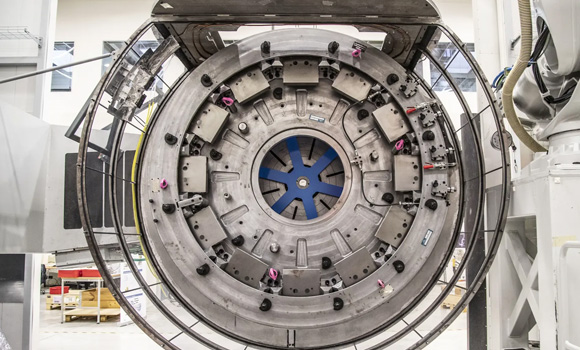
GKN Aerospace has announced the expansion of its Newington, Connecticut, USA, facility, featuring a new production line for the Additive Manufacturing of Fan Case Mount Ring (FCMR), a critical component of the Pratt & Whitney GTF engine powering Airbus’ A220 and Embraer E195-E2. The expansion is expected to create new jobs and further strengthen GKN Aerospace’s presence in the US.

The FCMR programme became the largest flight-critical Additively Manufactured component to achieve FAA certification and is on track for 100% serial production by the end of 2025. The component’s core structure, the additively fabricated ‘hot size ring’, is already being delivered from GKN Aerospace’s Trollhättan facility in Sweden, with final machining completed in Newington.
“Today we already produce around 30 FCMR units per month at our Trollhättan facility,” explained Sébastien Aknouche, SVP Material Solutions, GKN Aerospace. “Expanding our cutting-edge technology, developed in Sweden, to the US will support the full volume of FCMR production in one place. As well as ramping up our production for the FCMR, it will also enable us to expand our additive fabrication offering to other customers in the USA.”

GKN Aerospace has two facilities in Connecticut, Newington and Cromwell, and employs more than 450 people across the state. The expansion was supported by the Connecticut Department of Economic and Community Development and the Connecticut Governor’s Office.
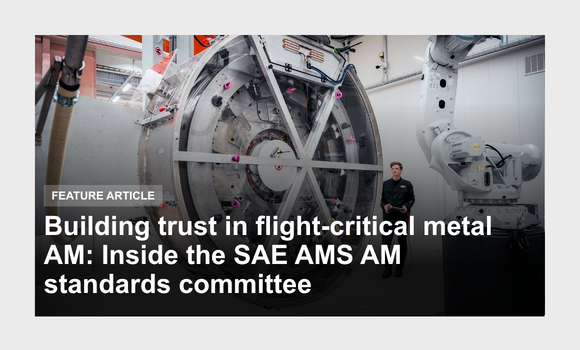
“This expansion in Connecticut marks a major milestone for GKN Aerospace and our Fan Case Mount Ring programme,” stated Joakim Andersson, President Engines, GKN Aerospace. “The combination of strong local support, the highly skilled workforce and the availability of an aerospace network and infrastructure here allows us to bring our latest additive fabrication technology into industrial-scale production, creating jobs and supporting our long-term relationship with Pratt & Whitney. We are proving that additive fabrication is not only technically transformative but also delivers real-world benefits in sustainability, lead-time and predictability for our customers.”
The company’s Additive Manufacturing process reduces material consumption, shortens production lead times, and is projected to achieve over 70% material savings. Critically, it also helps to strengthen global supply chains by offering an alternative production method.