Fraunhofer ILT develops EHLA and roller burnishing process for aircraft landing gear repair
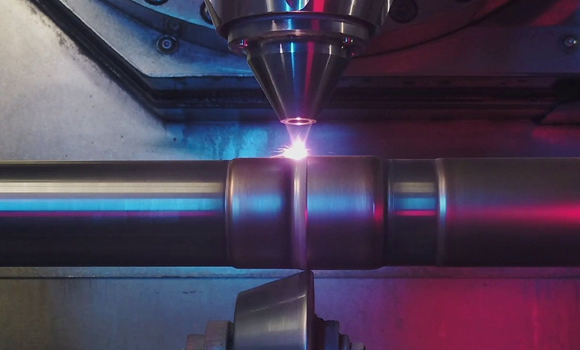
The Fraunhofer Institute for Laser Technology ILT, Aachen, Germany, is developing a repair process for high-strength aircraft landing gear components alongside Liebherr-Aerospace, headquartered in Toulouse, France, and Hegenscheidt-MFD, based in Erkelenz, Germany, as part of the LEGATO research project.
The work combines Extreme High-Speed Laser Material Deposition (EHLA), a powder-fed Laser Beam Directed Energy Deposition (DED-LB) process, with roller burnishing through the Simultaneous Coating and Roller Burnishing (SCaRB) approach.

“Our research focuses on three steps,” said Kim Julia Kallies, project manager at Fraunhofer ILT. “Restoring material locally, tailoring the mechanical properties of the surface layer, and reliably inspecting the resulting coating.”
Kallies and her research group are investigating material combinations relevant to the application, having already repaired 300M steel using matching material. For corrosion-resistant coatings, they are testing a martensitic stainless steel developed specifically for EHLA, among other materials. The researchers are also studying 15-5PH, a high-strength, corrosion-resistant steel used in landing gear structures.
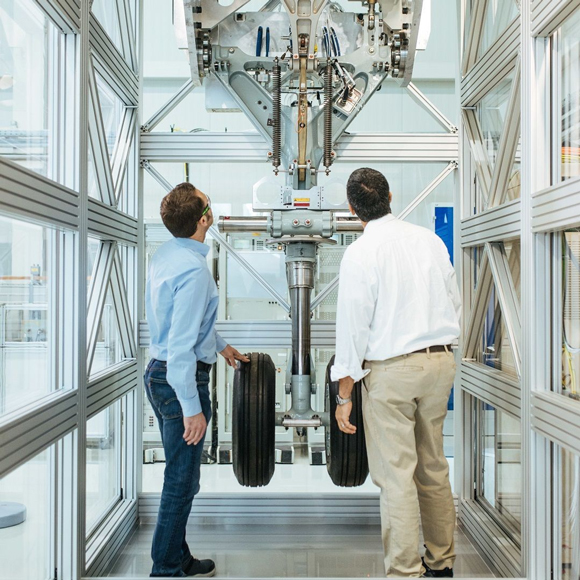
Liebherr-Aerospace is contributing actual components and damage patterns, as well as specifications regarding materials, hardness, surface quality, and low heat input. Hegenscheidt-MFD is assisting the project with its expertise in roller burnishing and deep rolling processes.
“Ultimately, it is not enough for a coating to perform well in the laboratory,” added Harald Betsch, Senior Expert Thermal Spraying/Welding in Materials and Processes, Liebherr-Aerospace. “What matters is whether the process is suitable for real landing gear components under load, including their materials, damage patterns and repair limits. These are precisely the requirements we bring to LEGATO from development, manufacturing and maintenance.”
The SCaRB approach combines EHLA deposition with roller burnishing immediately afterward. As the laser deposits metallic powder onto the component surface, a burnishing tool follows at a defined distance, working the newly deposited layer while the coating process is still underway.
EHLA’s high processing speed enables deposition and burnishing to take place in a single process sequence, while residual heat from the deposition process means the new layer remains warm and easier to deform plastically. The distance between the laser and burnishing tool determines how warm and deformable the layer remains when the tool reaches it. This distance helps control surface characteristics, hardness and residual stresses.
Hegenscheidt-MFD has developed a burnishing tool for the process, which Fraunhofer ILT integrated into the machine. The burnishing force can be adjusted by changing the tool’s feed rate, while interchangeable rollers are used to select the radius and hardness appropriate for each application.
Fraunhofer IWS is also contributing its laser-induced surface acoustic wave spectroscopy (LAwave) technology to the project. The LAwave technique uses laser-generated acoustic waves to assess the near-surface properties of the coating and underlying material. Further development and qualification are required before the combined repair process can be used in aerospace applications.
“The key for us is to use the layer while it is still warm, rather than finishing the EHLA coating in a separate operation afterward,” explained Kallies. “Roller burnishing smooths the surface while also affecting hardness and residual stresses. SCaRB therefore turns material deposition into a process that lets us tailor the repaired area to its intended function.”