FAME Symposium 2026 attracts record international attendance
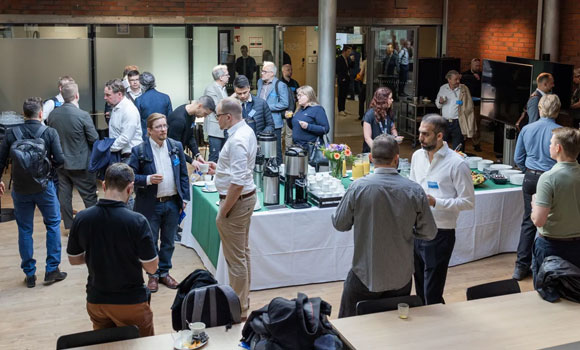
The Finnish Additive Manufacturing Ecosystem (FAME) Symposium 2026 brought together more than 100 participants from ten countries at LUT University’s Lappeenranta campus, Finland, on May 20–21. According to the organisers, this was the largest edition of the event to date, attracting representatives from industry, academia, start-ups, regulatory bodies and defence organisations.
The theme of this year’s symposium was Industrialising Research in Additive Manufacturing, focusing on the challenges and opportunities involved in transferring Additive Manufacturing technologies from research environments to industrial applications.
Over two days, participants discussed the adoption of AM across sectors, including energy, maritime, manufacturing and defence, with presentations examining both technical developments and implementation strategies.
Keynote presentations
The symposium opened with a keynote presentation by Benjamin Regener of NuclearIQ Solutions LLC, who addressed the role of Additive Manufacturing in critical infrastructure applications and discussed the regulatory and qualification challenges associated with wider adoption.
On the second day, Mika Vaskelainen (Patria Oyj) presented a case study on the redesign of a Hawk jet trainer bracket, outlining the process of converting a conventionally manufactured component into an AM-optimised design.
Programme highlights
Across twelve sessions and two parallel tracks, speakers covered a wide range of topics spanning the Additive Manufacturing value chain.
Energy and nuclear applications featured prominently, with presentations from Jukka Mononen (STUK) on AM products for Finland’s nuclear sector, Shaafi Shaikh (EOS Finland) on additively manufactured INCONEL 718 components for oil and gas applications, and Atharv Agarwal (LUT University) on tungsten components for nuclear fusion.
The maritime sector was another major focus area. Giuseppe Sarago (Fincantieri) discussed the company’s approach to implementing Additive Manufacturing within shipbuilding, while Mikael Parvikoski (RMC Finland) presented work on DED-Arc applications for ship structural connections.
Industrial case studies were also presented by Joonatan Huhtala (Konecranes), Roope Lavinen (John Deere Forestry) and Tommy Enlund (Wärtsilä), highlighting practical experiences of implementing AM technologies in manufacturing environments.
Sustainability-related topics were addressed throughout the programme, including presentations by Tuomas Puttonen (Aalto University) and Erik Haapa (University of Turku) covering life cycle assessment and resource efficiency in metal Additive Manufacturing.
Additional sessions explored AI-driven design, advanced process control, multi-material development and post-processing for industrial applications. Presentations included a discussion of deterministic AI by Alejandro Carcel Lopez (Cognitive Design Systems) and the relevance of the LUMI supercomputer to AM research by Jyrki Savolainen (CSC).
A featured Industry Pioneer Talk was delivered by Olli Nyrhilä, recognised for his role in the development of the metal Laser Beam Powder Bed Fusion (PBF-LB) AM. His presentation examined the evolution of metal AM and the factors influencing its continued industrial adoption.
Posters and exhibitors
Nine research posters were presented during the symposium, covering topics including robotic metal AM, Wire Arc Additive Manufacturing, natural-fibre composite feedstocks and gyroid heat exchangers.
The event also included an exhibition featuring Cognitive Design Systems, CSC – IT Center for Science, HAMK, LUT University, Oerlikon and Metal AM magazine.
The next FAME Symposium is scheduled to take place in Vaasa, Finland, on May 12–13, 2027.