Eplus3D and UCL additively manufactured rocket engine passes hot-fire test
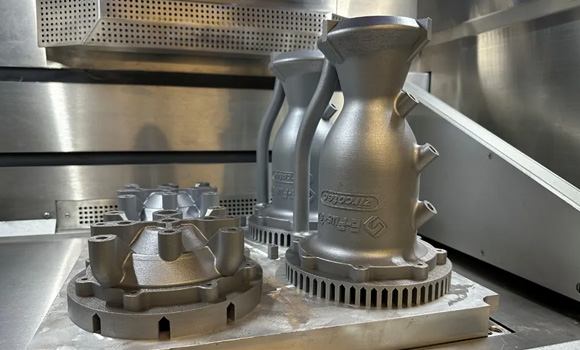
Through a collaboration with the University College London (UCL) and its student-led Rocket team, Eplus3D, headquartered in Hangzhou, China, has successfully additively manufactured a regeneratively cooled, bi-propellant rocket engine for the UK’s Race 2 Space 2025 competition.
As part of a project intended to demonstrate how Additive Manufacturing enables advanced cooling channels, integrated features and rapid development, the team produced the Excelsior engine in AlSi10Mg on Eplus3D’s quad-laser EP-M400S Laser Beam Powder Bed Fusion (PBF-LB) AM machine.
As technical partner, Eplus3D provided process consultation, and manufacturing execution for Excelsior’s complex thrust chamber and injector components. Excelsior achieved its target thrust of 5 kN during hot-fire testing, ranking fourth in the Nitrous Bipropellant category, and was one of only eight engines out of seventeen to survive all tests.
The project presented several technical challenges:
- Temperatures in the combustion chamber exceeded 2,500 K, requiring a robust cooling strategy to prevent material failure
- The design included fifty-eight internal coolant channels, coaxial swirl injector elements, and tight dimensional tolerances that demanded advanced manufacturing capability
- Material selection had to balance thermal conductivity, mechanical strength, density, and machinability
- The manufacturing process needed to be fast and cost-efficient to meet a student project’s limited timeframe

The Excelsior engine uses Isopropyl Alcohol (IPA) as both fuel and coolant, and Nitrous Oxide (N₂O) as the oxidiser. It is designed for a target thrust of 5 kN, a chamber pressure of 25 bar, and a theoretical specific impulse of 204 seconds. The engine is printed in two parts, the thrust chamber assembly, which includes the chamber and nozzle, and the coaxial swirl injector. These are joined via a bolted flange with Viton O-ring seals for leak-free operation.
The coaxial swirl injector incorporates fifteen elements. Each element has an inner orifice that delivers N₂O axially into the chamber, surrounded by an outer orifice that injects IPA in a swirling conical sheet. This swirling motion is achieved through three tangential inlet ports feeding a vortex chamber upstream of the orifice, imparting high tangential velocity for rapid atomisation. The geometry was optimised using the Linearised Instability Sheet Atomisation (LISA) model to maximise droplet breakup while maintaining stable operation. Dynamic response modelling was also performed to ensure that injector behaviour under pressure oscillations did not coincide with the engine’s acoustic resonance modes, which could cause combustion instability.

Cooling strategy
To survive high heat fluxes, Excelsior uses a triple cooling system. Regenerative cooling circulates the entire 0.59 kg/s IPA flow through an additively manufactured inlet manifold at the nozzle exit and into fifty-eight axial, single-pass coolant channels integrated into the engine walls.
Film cooling is provided by fifteen machined 0.6 mm orifices on the injector face, which direct 10% of the IPA flow along the chamber wall to form a protective liquid film. Finally, a Zircotec ThermoHold H2000 zirconia-based ceramic thermal barrier coating is plasma-sprayed onto the inner wall, reducing heat flux and mitigating thermal stress, particularly at the throat (the engine’s most critical region.)

Material Selection
AlSi10Mg was selected over traditional aerospace alloys such as Inconel 718 and CuCrZr due to its high thermal conductivity of approximately 165 W/m·K after stress relief, which enables rapid heat transfer to the coolant. Its low density of 2.7 g/cm³ allows for significant weight savings, and its machinability supports efficient finishing of sealing surfaces and precision features. The main drawback of AlSi10Mg is its reduction in yield strength at elevated temperatures approaching 600 K, which necessitated detailed thermomechanical stress analysis to verify survivability.
Manufacturing on EP-M400S
The manufacturing process was carried out on the EP-M400S PBF-LB Additive Manufacturing machine system, equipped with four 700 W lasers. A 60 µm layer thickness was used to achieve fine internal channel resolution and the smooth surfaces required for the injector’s performance.
Using its Design for Additive Manufacturing, Eplus3D reportedly enabled the design to be optimised for AM, minimising the risk of defects and reducing post-processing requirements. Manufacturing the engine as two integrated assemblies allowed for a substantial reduction in part count and assembly complexity compared to conventional manufacturing methods.
Testing and results
UCL Rocket’s first regeneratively cooled engine, Excelsior, was successfully hot-fired at Airborne Engineering Ltd. for Race 2 Space 2025, withstanding three hot-fire tests to achieve its target thrust of 5 kN.
Excelsior placed fourth in the Nitrous Bipropellant category and was one of only eight engines out of seventeen to survive all hot-fire tests. According to the teams, the project highlighted several key lessons, including the importance of thorough cleaning to prevent injector blockages, the need for reliable sealing solutions, and the ability of PBF-LB Additive Manufacturing to enable rapid, high-performance aerospace hardware development in a student-led environment.
The team also stated that the success of Excelsior demonstrates that advanced Laser Beam Powder Bed Fusion AM in AlSi10Mg can produce high-performance regeneratively cooled rocket engines within the constraints of a university project.