Empa explores metal Additive Manufacturing to extend life of damaged steel structures
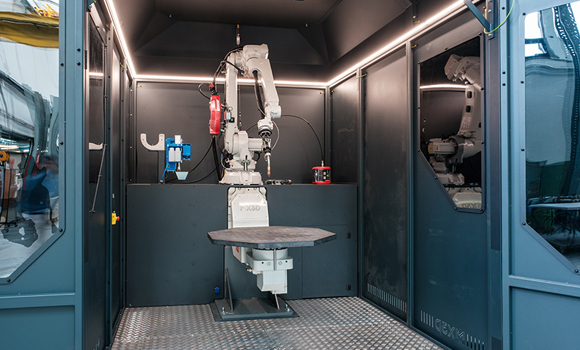
Researchers at Empa, the Swiss Federal Laboratories for Materials Science and Technology, based in Dübendorf, Switzerland, are investigating how steel components can be repaired or redesigned using metal Additive Manufacturing. The team aims to use Wire Arc Additive Manufacturing (WAAM), a form of arc-based Directed Energy Deposition (DED-Arc), to repair cracked parts of bridges and structural frameworks because permanently installed steel components are often difficult or very costly to replace.
“The key isn’t to apply as much material as possible,” explained Hossein Heydarinouri of Empa’s Structural Engineering laboratory. “The shape is much more important: An optimised geometry distributes stresses in such a way that the propagation of existing cracks is stopped or significantly slowed down.” For example, researchers from Empa and ETH Zurich were able to extend the service life of the damaged steel plates under investigation by up to four times as part of a master’s thesis project.

In extensive tests conducted in Empa’s construction hall, cracked steel plates were fitted with metal reinforcements of various shapes and then subjected to repeated loading. The results showed that all reinforced samples exhibited a significantly higher fatigue life than unrepaired control plates. Two-layer, stepped reinforcement geometries proved particularly effective.
At the same time, the study also highlights the limitations of the approach. If the geometry is chosen poorly, new stress concentrations can arise, for example, at the interfaces between the base material and the additively manufactured metal. “Our results show how important a targeted design of the reinforcement structure is,” said Heydarinouri.
Fatigue cracks are among the most common types of damage in steel construction, and targeted reinforcement is significantly more efficient than completely replacing the damaged component. “Using 3D printing, we can apply metal reinforcements exactly where they are structurally needed,” added Heydarinouri. “Repairs save material, energy, and costs.”
Despite the great potential, the path to practical application is still challenging. Metal Additive Manufacturing is currently carried out using industrial robotic systems that are difficult to transport. “Damaged components are usually installed within the structure,” said Heydarinouri. “Today, they would have to be taken to a workshop for repair, which isn’t always realistic in practice.” While there are initial approaches for mobile or portable robotic systems, further developments are needed for widespread on-site use. Nevertheless, the research team sees advantages for applications where components are easily accessible or can be removed during maintenance work.
In addition to repairing damaged components, the team led by Empa researcher Heydarinouri is also working on more advanced concepts. The combination of intelligent geometries, metal AM, and new materials enables metal structures that deliberately yield under extreme loads, absorbing energy in the process and then returning to their original shape as much as possible or at least avoiding permanent damage. In the future, they could be used as metallic damping elements for earthquakes or vibrations, for example, in bridges, buildings, or technical installations. Moreover, the Empa researcher sees potential in mechanical engineering, such as for lightweight yet highly stressed components in production machinery.
“3D printing gives us enormous geometric freedom,” said Heydarinouri. “We can specifically optimise structures – for example, to reduce weight while maintaining or even optimising load-bearing capacity.”
In addition, Empa materials scientist Maryam Mohri is researching how shape memory alloys (SMAs) can be used to specifically enhance material properties. These smart materials have the ability to return to their original shape after being deformed – for example, by heating. In this way, improved material properties can be combined with customised geometries, opening up new possibilities for material-efficient and adaptive metal components. The corresponding geometries are developed at Empa using numerical simulations and then tested experimentally. The researchers thus ensure that the additively manufactured components meet realistic conditions and are suitable for industrial applications.