DARPA grants $2.8M to Auburn’s NCAME for metal AM qualification
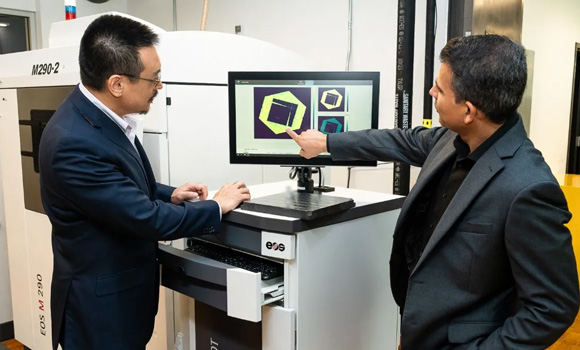
The USA’s Defense Advanced Research Projects Agency (DARPA) has awarded Auburn’s National Center of Additive Manufacturing Excellence (NCAME) up to $2.8 million over four years to support its Structures Uniquely Resolved to Guarantee Endurance (SURGE) programme, which aims to significantly expedite and economise how additively manufactured metal parts are qualified for use.

Currently, tuning a specific machine for qualification, i.e. to consistently produce identical parts, is both time consuming and expensive. However, the Department of Defense reportedly envisions a way to expand the nation’s defence industrial base during periods of surge demand.
Shuai Shao, NCAME associate director for research and innovation and McWane Associate Professor of mechanical engineering, shared, “We are supporting this DARPA initiative with NCAME’s advanced non-destructive evaluation capabilities. These methods allow us to detect and characterise volumetric defects in AM metallic parts with unparalleled precision, offering the knowledge needed to establish their process-structure-property-performance relationship with the help of in-situ monitoring and simulation.”
NCAME Director Nima Shamsaei, Philpott-WestPoint Stevens Distinguished Professor of mechanical engineering, added, “NCAME brings deep expertise in the structural integrity of additively manufactured metallic materials, particularly in fatigue and fracture behaviour. Our role is to rigorously validate how microstructural features and defects translate into performance, ensuring that predictive models align with the durability requirements of critical components.”
Stefano Beretta, visiting professor of mechanical engineering and structural integrity scholar, commented, “NCAME is advancing a probabilistic framework for component life estimation that captures the inherent variability in Additive Manufacturing. By quantifying uncertainty in defect distributions, microstructure, and loading conditions, we are developing predictive tools that move beyond deterministic limits.”
Shao, Shamsaei and Beretta are all co-PIs on the project.
NCAME’s contributions to SURGE will be integrated into research led by the University of Michigan with the goal of shifting industry from slow, machine-focused qualification methods to a flexible, data-driven process that certifies parts in real time. Other team members include University of Michigan-Dearborn; Texas A&M University; University of California, San Diego; Addiguru, a firm providing AM in-situ monitoring and issue detection technology; engineering software providers AlphaStar; and ASTM International.
“Distributed, on-demand production has always been the promise of Additive Manufacturing,” Shamsaei said. “Through SURGE, we’re helping to make that promise a practical reality.”