Dalhousie University keeps Canada’s submarines mission-ready with Additive Manufacturing
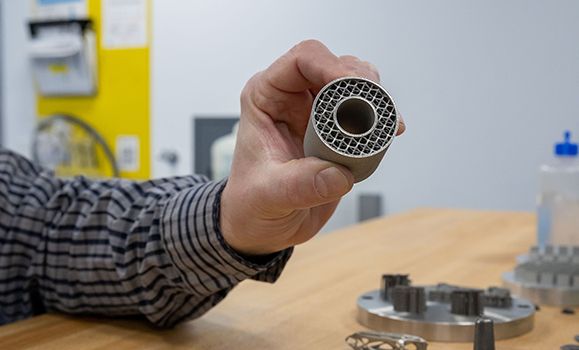
Dalhousie University, based in Halifax, Canada, is partnering with Defence Research and Development Canada to strengthen operational readiness, using advanced Additive Manufacturing to develop both critical submarine parts and the processes needed to produce them.
Already in motion, the federal government committed to procuring up to twelve new submarines in September 2024 to replace the Royal Canadian Navy’s Victoria-class fleet, which is scheduled for decommissioning in the mid-2030s. However, the first of the new submarines isn’t expected until 2035. Until then, Canada must keep its current fleet, built in the UK in the 1980s and acquired in the late 1990s, fit for duty.
Cameron Munro, a defence scientist with Defence Research and Development Canada (DRDC) at Halifax’s Atlantic Research Centre, shared, “One of the biggest hurdles for the Canadian Navy — and the military at large – is keeping our ships, submarines, and hardware operational for long periods. In Canada, we tend to use things beyond their original design life – 40 or even 50 years.”

While the approach maximises the value of costly military equipment, Munro notes that ageing hardware inevitably leads to malfunctions, and repairs are not easy, “If you need to replace a part on a submarine that was built 35 years ago, you may find that the manufacturer no longer exists.”
When parts aren’t available, Munro shared that the Navy is forced to engage tool-and-die foundries that use time-consuming techniques to custom-build components from scratch. “This kind of procurement can take years,” Munro shared. “And that’s not always an option when readiness is the priority.”
At Dalhousie, materials engineer Dr Paul Bishop has taken up the challenge by adapting advanced materials science and Additive Manufacturing techniques to meet the Navy’s needs. “Dalhousie has designed and commissioned an exceptionally comprehensive suite of infrastructure for this technology – globally competitive and nationally unique. That’s one of the key reasons the Navy came to us,” he stated.
The researcher is leading a partnership with DRDC, supported by NSERC, the Canadian Foundation for Innovation, and a consortium of industry partners, to create the parts and Additive Manufacturing processes necessary to keep naval vessels like the Victoria-class fleet mission-ready.
Highly specialised, the defence-standard naval alloys used in Canada’s vessels have never been the subject of additive material research. Dr Bishop and his team are the first to break them down to understand how to turn them into powder that can then be consolidated with lasers and other thermal processes to build replacements.
“No one, at least in the open literature, has done serious research into how these highly specific naval alloys respond to Additive Manufacturing,” Bishop said. “That’s the first fundamental piece of work we’re doing – determining which alloys can be printed and what the optimal manufacturing process looks like.”
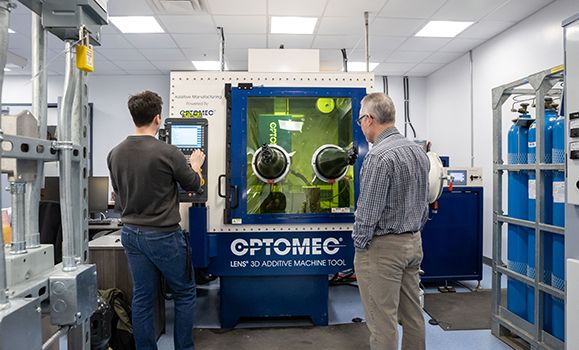
The project is placing Dalhousie in a key role between DRDC and emerging additive material manufacturers taking root in Canada. These fabricators are resistant to taking on Navy jobs that require extensive research and development but only yield a few parts. Large-scale production jobs are more profitable, making small-batch Navy contracts less attractive.
By doing the research to determine material compositions, design and manufacturing specifications, Dalhousie can tee-up projects for fabricators, allowing them to produce the parts without the front-end investment of R&D.
Munro added, “Our role at Dalhousie is to develop the fundamental ‘recipes’ – what materials work, how to print them, and the processing parameters that yield products of a high metallurgical quality. Once we figure that out, companies take the research we develop in the lab and apply it at a larger, commercial scale.”
Munro explained that Dalhousie’s involvement provides the added benefit of allowing the Royal Canadian Navy to own the R&D that produces their parts. He stressed the importance of this as it allows them to avoid getting locked into a single supplier’s proprietary system and the ability to reduce lead time and cost by shopping contracts for new parts to multiple vendors.
“This project isn’t just about making one or two components — it’s about building long-term industrial capacity in Canada,” said Munro. “We’re developing processes and proving they work, so the Navy can use them in the future without needing to start from scratch.”
He added that Additive Manufacturing will allow the military to change how it thinks about maintenance. Instead of stockpiling spare parts in anticipation of malfunctions, he said they will be able to produce components from processes developed at Dalhousie on demand, reducing costs while ensuring the Navy has what it needs, when it needs it.
Dr Bishop agreed, saying the project will empower the navy with much of the knowledge they need to confidently implement and operationalise Additive Manufacturing to meet ongoing maintenance challenges.
“The real goal is to provide the Navy and the supporting industry partners with data that define reliable processes that can be used at scale – passing the baton so to speak, so they can then work together to implement the outcomes in Canada,” stated Dr Bishop
Ultimately, it’s about self-reliance, said Munro. “We need to increase our ability to support Canada’s military platforms domestically. This collaboration between DRDC, Dalhousie, and industry is helping to build that capacity.”
www.dal.ca