Copper AM cold plate improves AI data centre cooling
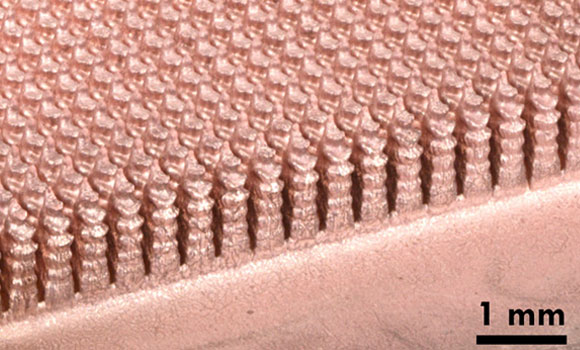
Researchers from University of Illinois at Urbana-Champaign and Fabric8Labs, San Diego, California, both USA, have published findings in Cell Reports Physical Science on a topology-optimised liquid cooling cold plate manufactured in pure copper using electrochemical Additive Manufacturing, reporting improved thermal performance and lower pressure drop for AI data centre applications.

The study addresses growing thermal management demands driven by AI computing, where conventional liquid-cooled cold plates can face a trade-off between thermal performance and hydraulic efficiency. While topology optimisation can improve cooling designs, the resulting fine-scale geometries may be difficult to manufacture using conventional methods.
To overcome this limitation, the researchers combined topology optimisation with electrochemical Additive Manufacturing to directly produce high-resolution pure-copper cold plates featuring sub-100 μm structures.
Experimental testing showed that the topology-optimised cold plate achieved up to 32% lower thermal resistance at a fixed flow rate compared with conventional pin-fin designs. At equal thermal resistance, the design also demonstrated up to 68% lower pressure drop.

According to the researchers, an accompanying data centre energy analysis suggested that, under the stated assumptions, the cooling approach would account for approximately 1.1% of total data centre energy consumption.
The authors state that the workflow helps bridge the gap between computationally optimised cooling architectures and manufacturable hardware, offering a potential route toward improved liquid cooling systems for future electronic devices and AI infrastructure.
‘Ultra-high-performance cold plate development through topology optimization and electrochemical additive manufacturing’ is available here.