Centre for Industrial Photonics develops laser-assisted cold spray Additive Manufacturing
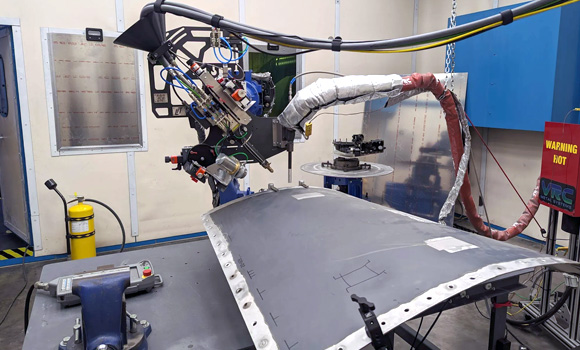
The Centre for Industrial Photonics (CIP) at the Institute for Manufacturing (IfM), Cambridge, UK, has developed a new laser-assisted cold spray (LACS) Additive Manufacturing process. The technology uses localised heating of a supersonic powder stream with a laser to deposit metals and cermets to build, coat or repair parts. The method is said to overcome the high-temperature and material limitations of comparable techniques such as thermal spraying.

The CIP team has demonstrated the effectiveness of LACS in aerospace applications, where high-precision and localised material deposition are critical. This technique enables on-demand fabrication of high-quality coatings and component repairs, extending aircraft lifespan. Additionally, LACS reduces material waste and energy consumption compared to traditional methods, supporting the industry’s transition towards net-zero emissions.
The LACS method has the potential to offer several advantages over traditional techniques, including the rapid production of custom, complex parts with minimal material waste. It enables the integration of multiple materials to achieve enhanced properties, allowing components to be tailored to specific applications. Additionally, it eliminates the need for costly moulds or extensive machining, making it well-suited to industries requiring low-volume, high-precision parts.
LACS is intended to act as a sustainable, cost-effective and efficient option for repair, and, in more extreme cases, re-manufacture from a base part. Traditional repair techniques, such as welding, are unsuitable for certain high-performance applications, for example 6000 series aluminium. The heating needed to adhere the new and old material together impacts the strength and reliability of the repaired part.
Under the leadership of Professor Bill O’Neill the team at CIP have shown that the relatively low-temperature, localised laser heating used in LACS allows new material to be added without negative side effects. Furthermore, as with Additive Manufacturing, the LACS equipment has the potential to be programmed to build to a specified design from a computer model, allowing complex, digital designs to be quickly turned into tangible products.
The next step for the CIP lab is to enhance the capability of LACS to additively manufacture a shape. The team are exploring several avenues to achieve this goal, including mounting the part on a moving arm to allow it to be moved in 3D space and increasing the control over the direction of the powder stream to produce crisp, smooth edges.
O’Neill stated, “Currently, we have little control over the shape of deposition of the powder. This is not an issue for coatings but presents a significant restraint for part-building applications. Our next goal is to find a solution to this limitation, and we already have some very promising results.”
“The potential applications for LACS are limitless and we are motivated to deliver a technology that can significantly aid in the transition to net zero, through both a more efficient, low-waste manufacturing technology and the doors it opens for sustainable product development,” he concluded.