Avio Aero showcases GE Aerospace AM ecosystem
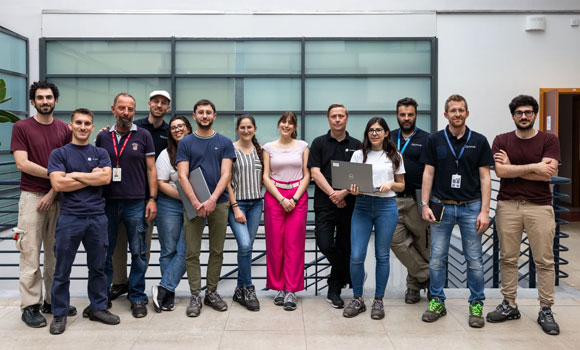
Avio Aero and Colibrium Additive, both part of GE Aerospace’s Propulsion & Additive Technologies (P&AT) business, recently showcased their integrated global Additive Manufacturing ecosystem, bringing together expertise in materials, machine development, process engineering and industrial production.
Rather than operating independently, the organisations collaborate across multiple sites to accelerate the development, qualification and industrialisation of metal Additive Manufacturing technologies.
Since opening in 2013, Avio Aero’s facility in Cameri, between Milan and Turin, Italy, has evolved into one of GE Aerospace’s flagship metal Additive Manufacturing production centres, manufacturing aerospace engine components using Electron Beam Powder Bed Fusion (PBF-EB) at an industrial scale.
Although Cameri is the centre of Avio Aero’s metal Additive Manufacturing activities, it forms part of a wider ecosystem spanning the Turin Additive Laboratory (TAL), the Brindisi facility, AP&C’s metal powder production operations and Colibrium Additive’s engineering and machine development teams in Europe, Canada and the USA.
“Additive Manufacturing is complex because you’re not just 3D printing something, you’re managing certified machines, validated processes, unique materials and rigorous inspections,” explained Fausto Asvisio, Commercial Director at Colibrium Additive. “Success depends on every team working together with a common goal. Collaboration is what makes the entire process work.”
Continuous improvement through collaboration
According to Dario Mantegazza, Chief Manufacturing Engineer, Additive Business, Avio Aero, the company’s investment extends beyond production capacity to encompass technology development and closer collaboration across the GE Aerospace additive network.
“We are investing in capacity and collaboration, but also in new technology,” he explained. “Our priorities remain safety, quality, delivery and consistency before productivity and cost. Today, we are operating on a completely different scale.”
One recent example brought together specialists from AP&C, Avio Aero, Colibrium Additive and GE Aerospace to apply GE Aerospace’s proprietary Flight Deck lean operating model. Working as a single cross-functional team, they reduced powder losses while improving manufacturing costs and sustainability performance.
The initiative also highlighted the importance of close coordination between powder producers, machine developers and manufacturing engineers, as metal powder characteristics directly influence process stability and component quality.
Collaboration driving titanium aluminide production
A key example of this integrated approach is the industrialisation of titanium aluminide (TiAl) low-pressure turbine blades for the GE Aerospace GE9X engine. Manufactured using AP&C-produced TiAl powder on Colibrium Additive PBF-EB machines, the blades weigh around half as much as conventional nickel-alloy equivalents, contributing to improved fuel efficiency compared with the GE90-115B engine.
“We are always focused on reducing the cost of the low-pressure turbine, and the titanium aluminide blades are key to achieving this,” said Mantegazza. “However, the manufacturing process combines advanced electron beam technology, materials science and precision engineering. It simply would not be possible without close cooperation across our global additive teams.”
“We would not be where we are today without access to this global expertise,” Mantegazza continued. “Our entire additive value chain—from qualifying powders and machines to validating manufacturing processes—must work seamlessly to meet the demanding requirements of the aerospace industry.”
Developing the next generation
That collaborative approach also extends to research through the Turin Additive Laboratory, established in 2017 by Avio Aero and the Polytechnic University of Turin. The laboratory supports process development while helping transfer research into industrial production.
“Our main goal is to support our global additive value chain by improving Additive Manufacturing processes,” explained Dario Mula, Plant Leader at TAL. “Our focus is on increasing productivity and efficiency while reducing the cost of Additive Manufacturing components.”
Looking ahead, Avio Aero is applying the same collaborative approach to automation and artificial intelligence.
“AI is certainly starting to make its mark, particularly in inspection,” said Andrea Palumbo, Consulting Engineer – Additive Technology at Avio Aero. “Human experts still make the final decisions, but AI is helping accelerate image analysis. We are taking a pragmatic approach because safety and precision remain our priorities. At the moment, AI is augmenting human expertise rather than replacing it.”