amsight highlights data-driven quality management in Additive Manufacturing
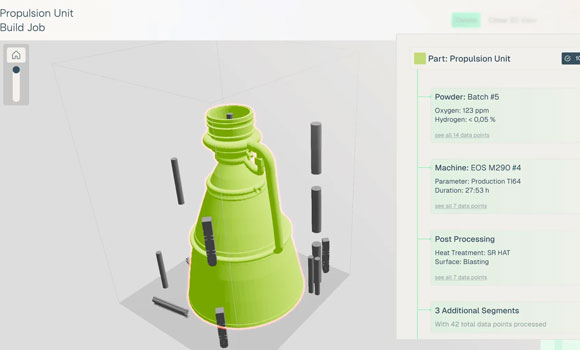
amsight, headquartered in Hamburg, Germany, has highlighted the growing role of digital quality management in production-scale Additive Manufacturing, as manufacturers face increasing demands for traceability, process stability and quality assurance.

In a recent amsight press release, Harry Kleijnen, associated with Additive Center and involved in full-process data capture initiatives alongside Melotte, reported that the industry’s focus is shifting from proving that parts can be produced to demonstrating process capability and repeatability at scale.
“’Data-driven’ is only possible when you have deep insights in what your process actually is capable of,” Kleijnen stated, referring to the requirements of regulated supply chains, where quality evidence must be repeatable and defensible.
According to Kleijnen, production data is often distributed across machine logs, powder records, post-processing documentation, inspection reports and spreadsheets. In these environments, investigating a non-conformance can begin with reconstructing information from multiple sources before root-cause analysis can take place.
“For the regulated industries, if you need to provide an audit trail, you will do this manually. It takes a lot of time,” he stated. The objective, then, is to reach a point where it becomes “press on the button to get a complete audit trail of your products.”
Kleijnen noted that amsight was developed to connect data generated throughout the Additive Manufacturing process chain, linking powder, process and quality information within a single system.

“It immediately starts as time saving on reporting and analysis,” he stated, adding that early benefits can include faster reporting cycles, improved visibility of process drift and reduced reliance on what he described as “Excel heroics” when customers or auditors request information.
He also drew a distinction between collecting production data and controlling manufacturing processes.
“Monitoring data alone isn’t process control. What matters is being able to connect process variation and critical-to-quality factors to product outcomes, building the foundation for process maturity and, ultimately, SPC-driven stability,” he explained.
Kleijnen believes wider adoption of connected data environments could influence expectations throughout the Additive Manufacturing supply chain. As manufacturers gain access to more comprehensive production data, they may be better able to identify both process-related and equipment-related issues.
“Data is now the route to reliability, and reliability is the route to scale,” he concluded.