AI framework improves defect detection in AM alloys
Researchers from South Korean organisations Pohang University of Science and Technology (POSTECH), Korea Institute of Materials Science (KIMS), and the Hyundai Motor Group, and the Japanese University of Osaka have published research in Acta Materialia detailing their development of an AI framework to detect defects in additively manufactured materials.

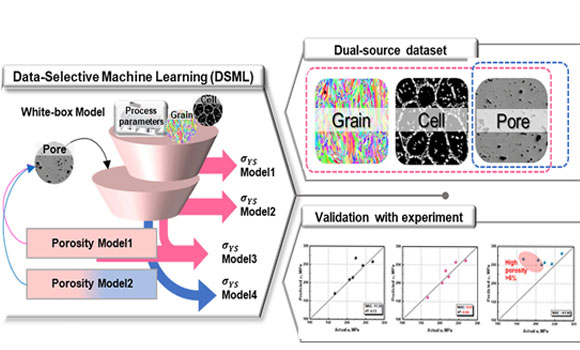
The yield strength of alloys manufactured via Laser Beam Powder Bed Fusion (PBF-LB) Additive Manufacturing remains difficult to predict due to defect-driven variability that cannot be captured by conventional near-dense empirical equations. In ‘Data-selective machine learning framework (DSML) for defect-aware, interpretable yield-strength prediction for LPBF-fabricated AlSi10Mg alloys’, the authors developed a data-selective machine learning (DSML) pipeline that integrates data-driven black-box modelling with physics-informed white-box modelling through symbolic regression, enabling the derivation of a defect-aware, interpretable closed-form equation.
A dual-source dataset was constructed, comprising forty-four fully labelled datasets – including process parameters, microstructural features and mechanical properties – alongside 111 process-only datasets containing porosity data. The DSML framework identifies key descriptors and incorporates a porosity sub-model into a closed-form yield-strength equation, explicitly accounting for the influence of process-induced defects.
Validation was conducted using AlSi10Mg produced by PBF-LB Additive Manufacturing under six distinct conditions. Results indicate that the porosity-aware white-box model achieves a coefficient of determination of 0.90 and a mean absolute error (MAE) of 9.51 MPa, outperforming both the black-box model and a widely used cell-size-based empirical relation (MAE = 41.98 MPa).

The derived terms are consistent with established mechanisms, including effective load-bearing reduction due to pores and boundary-mediated strengthening, while maintaining dimensional consistency. This enables the development of process–design maps for defect-aware optimisation.
By incorporating defect effects into an interpretable equation and validating against independent experimental conditions, the researchers noted that their study presents a reproducible, physics-consistent approach to understanding process–structure–property relationships in AM AlSi10Mg, and provides a scalable framework for integrating additional strengthening mechanisms in future Laser Beam Powder Bed Fusion materials.
The paper is available here.