AddMamBa advances recycled construction steel for AM facade brackets
AddMamBa, the BMWE-funded research project at the RWTH Aachen University Chair Digital Additive Production (DAP), is investigating how CO₂ emissions and resource consumption in the construction sector can be reduced with a focus on optimised, additively manufactured, and reusable facade brackets made from recycled steel. These components enable targeted reductions in material usage as well as thermal weak points.
According to the UN Global Construction Report 2024/25, approximately 34% of global energy-related CO₂ emissions and 32% of worldwide energy consumption are attributable to the construction sector. As a result, strategies focused on resource efficiency, circular economy approaches, and the reuse of construction materials are gaining importance in both research and industrial practice. Additive Manufacturing is regarded as a key enabling technology for economically utilising secondary raw materials while producing functionally optimised, material-efficient components.
From construction waste to metal powder for Additive Manufacturing
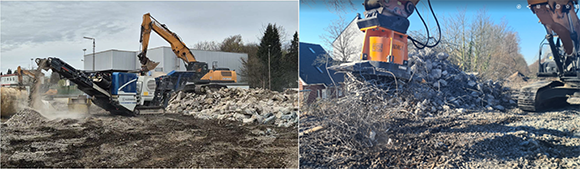
The research focuses on two types of components: facade brackets for ventilated facade systems (VHF) and connectors for load-bearing structures. As part of the project, these components are manufactured using Laser Beam Powder Bed Fusion (PBF-LB). The required metal powder is produced from steel scrap, which is first sorted by age, grade (e.g. reinforcing steel or structural beams), and condition, then analysed for its chemical composition. The powder is then produced using gas atomisation (VIGA). In a further step, the powder is sieved to obtain a particle size fraction of 15-45 micrometres that ensures a uniform layer build-up in the PBF-LB process.
This approach is intended to ensure that the recycled steel meets the quality requirements for load-bearing facade components.
Optimised, circular, and additively manufactured
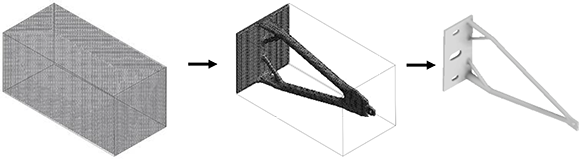
Due to the nature of the manufacturing process, facade connections can be individually adapted to building geometry, substructure configuration, and regional requirements, without additional costs for dedicated tools or moulds. Topology optimisation enables load-path-oriented material distribution, improving mechanical load-bearing performance while simultaneously reducing thermal weak points such as thermal bridges.
A digital planning tool developed within the project helps users select suitable bracket solutions. “After entering relevant building and facade data as well as the substructure configuration, the tool provides a robust basis for identifying the most suitable bracket in each case,” explained researcher Joana Schulte. The tool takes into account relevant standards, in particular DIN EN 1991-1-4/NA.
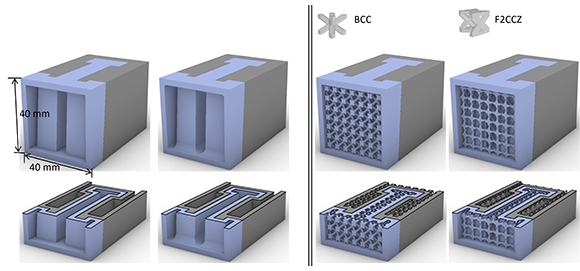
In addition, the project applies a life-cycle-oriented design approach: the components are designed to be demountable, separable by material type, and reusable.
Outlook and life cycle assessment
As part of a Life Cycle Assessment (LCA) conducted in accordance with DIN EN 15804, initial calculations based on conservative electricity-mix scenarios indicate a Global Warming Potential of 23.8-33.5 kg CO₂ equivalents per kilogram of component (2030), with a further downward trend expected as the share of renewable energy increases, according to the project team.
The analysis also shows that offsetting the higher manufacturing-related emissions, associated with the developed approach, through operational savings is most pronounced in buildings with conventional gas heating systems. When combined with modern heat pump systems, this effect is less significant.
For this reason, the circular economy aspect of the project is particularly important. In experimental trials, approximately 60% of usable metal powder was recovered from the processed steel scrap (30 kg of powder from 50 kg of scrap). This demonstrates that recycled steel can, in principle, be qualified for AM of functionally relevant facade connections.
The material-pure disassembly of newly developed and further optimised brackets and connector solutions provides an additional significant contribution toward closed material cycles.
Industry and practice
The research team stated that, for architectural firms, engineering consultancies, facade contractors, and manufacturers of connection elements, the project offers valuable insights. Additive Manufacturing not only enables functionally optimised geometries but also unlocks the potential to convert steel scrap into high-quality components, thereby helping to close material loops in the construction sector.
The project has developed an application pathway for making secondary materials usable within the AM process chain for the construction sector. This outcome is also relevant for powder manufacturers and AM users.
The project consortium is as follows:
- Paul Kamrath Ingenieurrückbau GmbH
- RSB Rudolstädter Systembau GmbH
- Laser Melting Innovations GmbH
- RWTH Aachen University
- Chair Digital Additive Production (DAP)
- Institute of Steel Construction – Sustainable Metal Building Envelopes Teaching and Research Area (MLB)
- Chair for Steel and Lightweight Construction (STB)
The research and development project “Additive Manufacturing of 3D Connection Elements in Construction (AddMamBa)” is funded by the German Federal Ministry for Economic Affairs and Energy (BMWE) under the Lightweight Technology Transfer Program (funding code 03LB3019B) and is managed by Project Management Jülich (PTJ).