Addiguru updates metal AM monitoring platform
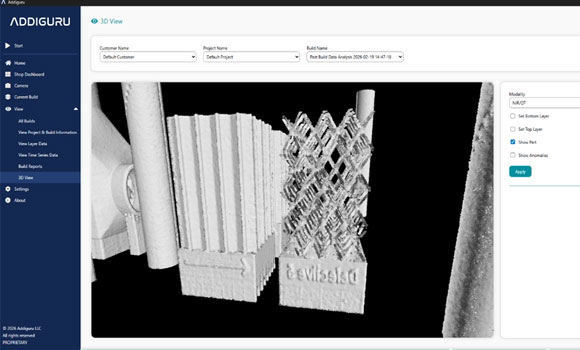
Addiguru, based in Metairie, Louisiana, USA, has announced the latest release of its multi-modal automated in-situ monitoring platform for metal Additive Manufacturing, alongside a new Enterprise on-premise solution designed for fleet-level deployment.

The company states that the platform can detect part swelling and geometric distortion 50–100 layers before they occur. Rather than relying on melt pool imagery alone, Addiguru combines long-wave infrared (LWIR) thermal data, optical process monitoring signals and machine control parameters. Through this multi-modal approach, early thermal signatures linked to swelling and distortion are identified long before visible geometric deviation appears in camera data. This allows operators to intervene during the build process, reducing scrap, protecting high-value components, and improving overall yield.
Addiguru’s platform combines automated anomaly detection with statistical modelling and multi-sensor data fusion. By correlating optical, thermal, and machine data streams, the system increases signal confidence while reducing false positives. Addiguru reports statistical accuracy of more than 95%, with 95% confidence, based on validation across multiple builds, including correlation with post-build CT inspection results. This approach provides reliable, explainable insight, supporting engineering judgement with data-backed indicators rather than isolated single-sensor signals, states the company.
The latest platform release is said to include:
- Real-time recoat issue detection with immediate alerts to prevent build interruptions
- Layer-by-layer thermal anomaly detection to identify out-of-spec conditions early
- Predictive swelling and distortion alerts 50–100 layers in advance
- Gas flow variation detection linked to potential surface or spatter issues
- Live data interrogation, enabling engineers to review and investigate issues during the build
Together, these capabilities provide earlier visibility into process behaviour and enable faster, more informed decision-making.
Addiguru’s machine-agnostic architecture is already integrated across major metal additive systems. The platform currently connects with machines from EOS GmbH, includes a recently released integration with Nikon SLM Solutions, and is actively developing a connection with Renishaw.
The company states that by combining Addiguru’s in-situ monitoring outputs with machine parameters such as oxygen levels, build plate temperature, and build metadata, users gain further insight into root cause without being tied to a single OEM ecosystem.
Alongside machine-level monitoring, Addiguru has introduced Addiguru Enterprise, an on-premise solution intended to enable secure, centralised monitoring of an entire machine fleet.
Key capabilities include:
- Fleet-wide visualisation across all connected machines
- Centralised data aggregation from edge-based monitoring systems
- Structured, actionable insights for quality and process teams
This allows manufacturers to monitor multiple systems from one location, rather than relying on machine-level visibility alone.
“Early detection only matters if it is reliable,” said Shuchi (SK) Khurana, CEO of Addiguru. “By fusing optical, thermal, and machine control data, we are increasing probability of detection while identifying distortion significantly earlier than optical systems alone. Our goal is to give engineers insight they can trust across different machine platforms.”