ADDere reports hot-wire DED machine deliveries
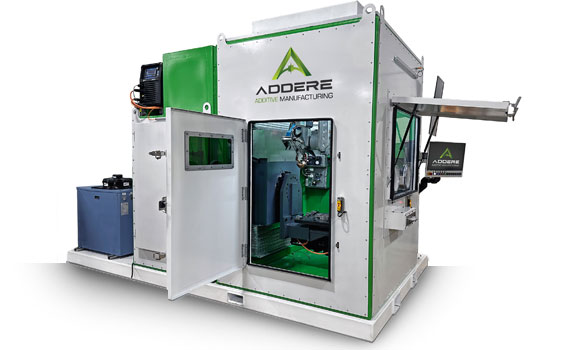
ADDere, based in Waukesha, Wisconsin, USA, has highlighted recent deliveries of its Directed Energy Deposition (DED) Additive Manufacturing machines. ADDere’s AM machines use high-powered lasers and pre-heated standard welding wire, ideal for building large-scale parts.
The company reported it recently delivered an 810 System DED machine to the US National Institute for Aviation Research (NIAR) in Wichita, Kansas, where it will support advanced materials and manufacturing process development for the aerospace sector. Within the coming month, ADDere will also deliver an 805 System to the University of Illinois Urbana-Champaign, expanding the technology’s presence in academic research and workforce development.
ADDere also highlighted its long-standing relationship with GKN Aerospace. GKN evaluated the technology in ADDere’s early years and chose it for installation, with ADDere machines now exclusively manufacturing Ti-6Al-4V components for aerospace applications.
The company offers three main paths to the technology: standard production systems, custom-engineered machines, and ADDere Additive Engines that integrate the deposition head, hot wire delivery system, and control software onto a customer’s existing robot platform, currently compatible with ABB, KUKA, and Fanuc systems.
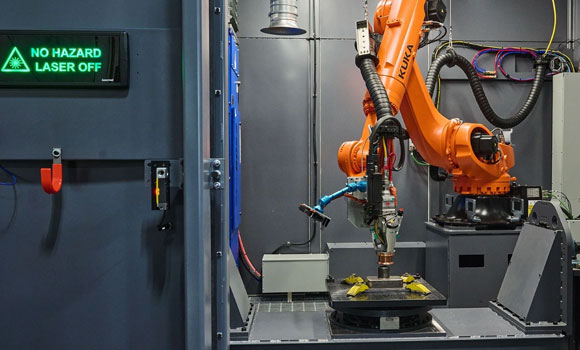
ADDere’s hot-wire DED process
The proprietary hot wire delivery system reportedly increases deposition rates by 20-40% compared to cold wire delivery, while simultaneously improving the metallurgical quality of the deposited material. Combined with a high-speed, real-time closed-loop sensor suite and purpose-built control software, the company claims that the process achieves part densities greater than 99.99% with virtually no impurities, results that meet or exceed casting-grade requirements for structural and flight-critical applications.
The platform supports titanium alloys, including Ti-6Al-4V, Inconel 625 and 718, stainless steels, Invar 36, copper-nickel alloys, and other superalloys. Build volumes range from compact machines ideal for research and small build sizes, to multi-metre custom configurations designed around a customer’s specific part geometry and production environment.
The standard machine lineup anchors around 8 kW laser platforms. The ADDere 810 System delivers an 8 kW laser source with a 1 m³ build envelope, purpose-built for production-scale titanium, nickel superalloy, and stainless-steel components. The ADDere 805 System offers the same laser power in a more compact 50 cm x 50 cm x 50 cm working envelope, making it well-suited for research institutions and targeted production applications where build volume requirements are more constrained.
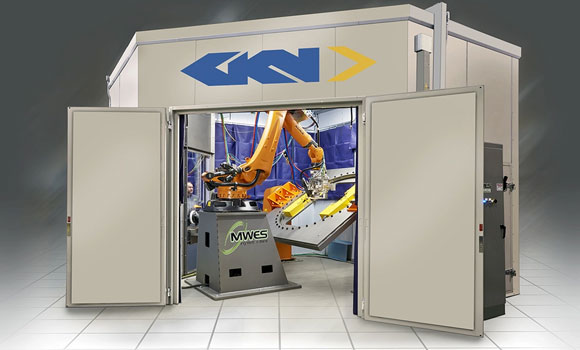
Custom DED machines
Beyond its standard machine lineup, ADDere has developed significant expertise in configuring custom systems around specific customer parts and production requirements. This engineering capability, drawing on Midwest Engineered Systems Inc.’s (MWES) 35 years of experience integrating complex automation machines across some fourteen industries, allows ADDere to design a complete manufacturing cell around a customer’s geometry, material, throughput, and facility constraints.
The company states that for manufacturers facing parts that simply do not fit the standard box, this custom path represents an alternative to either accepting the limitations of off-the-shelf systems or abandoning the additive route entirely.
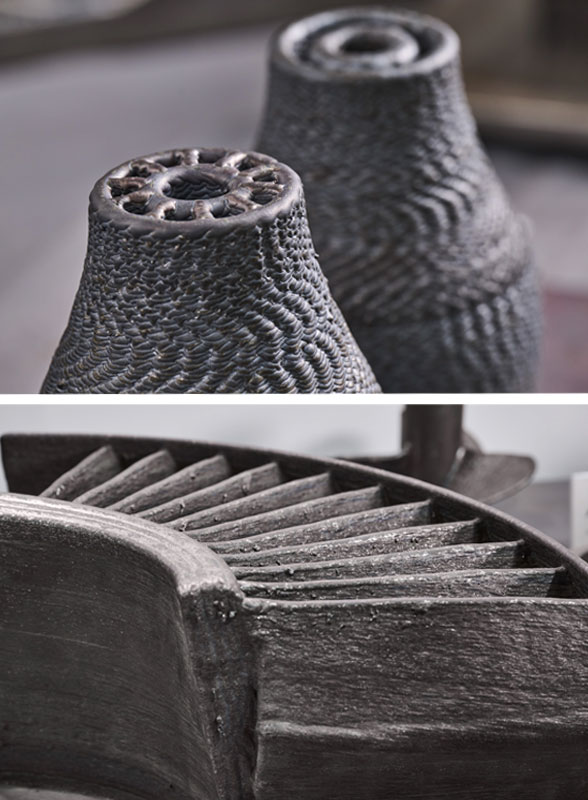
Contract manufacturing
ADDere also operates as a contract manufacturing partner, manufacturing customer parts on ADDere’s own production machines in Wisconsin. This service is available for both first-article and prototype runs as well as ongoing production contracts, giving manufacturers a low-risk path to evaluate the technology against their actual parts and materials before committing to capital equipment.
The prototyping path, in particular, is said to address one of the most common barriers to AM adoption: the difficulty of proving out a process without owning it. ADDere works with customers to translate their CAD geometry into print-ready builds, produce near-net-shape parts, and deliver components that can be machined, inspected, and qualified against the customer’s own standards.