Aconity3D and SWMS achieve first-time-right Additive Manufacturing with digital twin
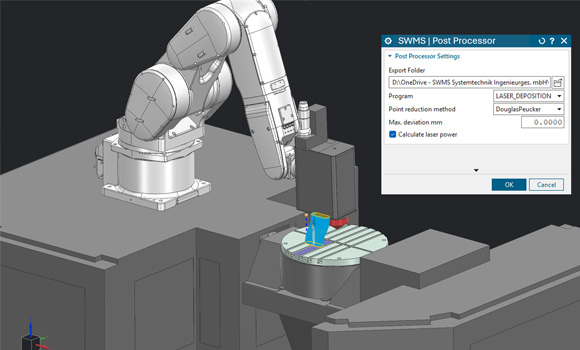
Aconity3D, Herzogenrath, Germany, has shared that together with SWMS Systemtechnik, an experienced technology partner for industrial software applications, it has succeeded in digitising and virtualising the AM process through digital twins.
SWMS’ core competencies Knowledge Based Engineering, CAx automation, and path-based process planning for AM and AFP, enable a realistic simulation of manufacturing that includes collision checking, axis limits, material deposition, and singularity detection. While classical CAM machines only deliver a static emulation, the digital twin goes further and maps the physical dynamics of the real system. The virtual environment encompasses both machine behaviour and manufacturing programmes, becoming the digital shadow of the real process.
This makes the digital twin not just a technical gimmick in research, but a strategic tool in industrial practice as costly misprints are reduced, downtime minimised, and valuable resources saved.
The complex, curved geometry of the part poses significant challenges not only to the software but also to the machine. Without digital simulation, faulty material deposits and imprecise layer transitions would quickly have resulted in scrap. This is risk can be detected and avoided early on thanks to the digital twin.

A particularly demanding demo part, with curved, non-planar geometry pushing conventional layer strategies to their limits, served as a test object for the digital process chain. Preparation was done in Siemens NX, with export via a post-processor developed by SWMS. This example demonstrates how digital twins enable precise process planning even for complex geometries, saving resources, time, and costs. The challenge lies in continuously adjusting layer height through precise variation of laser power and wire feed required the highest accuracy.
In Additive Manufacturing, precise process planning is crucial, it determines whether a part is successfully produced or ends up as costly scrap. Every avoided misprint saves expensive resources and energy, reduces downtime, and increases planning reliability. By seamlessly combining toolpath planning in Siemens NX with subsequent validation in AconityCOMMAND, errors can be detected and avoided early. This contributes significantly to resource conservation and energy efficiency already in the planning phase, resulting in less scrap, shorter downtime, and an improved ecological footprint.
“Our goal is batch size one – without compromises on quality, sustainability, or economy,”
explained Michael Stockschläder of Aconity3D. “With the digital twin as an intelligent planning partner, we are a big step closer to making First Time Right a reality.”
This development was accompanied by the Additive Manufacturing Lab at Rosenheim Technical University of Applied Sciences which, through scientific expertise, ensures that the latest findings flow directly into industrial application.
aconity3d.com