BMW Group looks to Wire-Arc Additive Manufacturing for lightweight and sustainable vehicle components
At the Additive Manufacturing Campus in Oberschleißheim, Germany, the BMW Group reports it is using wire arc Additive Manufacturing (WAAM) for the production of metal vehicle components and tools. The wire-based Directed Energy Deposition (DED) technology is allowing the company to produce parts that are lighter and more rigid than comparable die-cast parts currently manufactured in series production. These components can also be produced more sustainably, thanks to lower energy requirements and less material waste.
BMW stated that in the future, the plan is to use components manufactured using the DED process in BMW Group production vehicles.
The DED process is particularly suitable for large components
The large width and height of a single welding seam means that components can be produced extremely quickly using DED. In contrast to laser beam melting, which is already used in prototype and small series production at the BMW Group, DED is particularly suitable for larger components. The typical wall thicknesses are well suited to components in the body, drive, and chassis areas. However, tools and devices can also be manufactured using this high-tech process, which is also used in the aviation industry.

Development at the Additive Manufacturing Campus
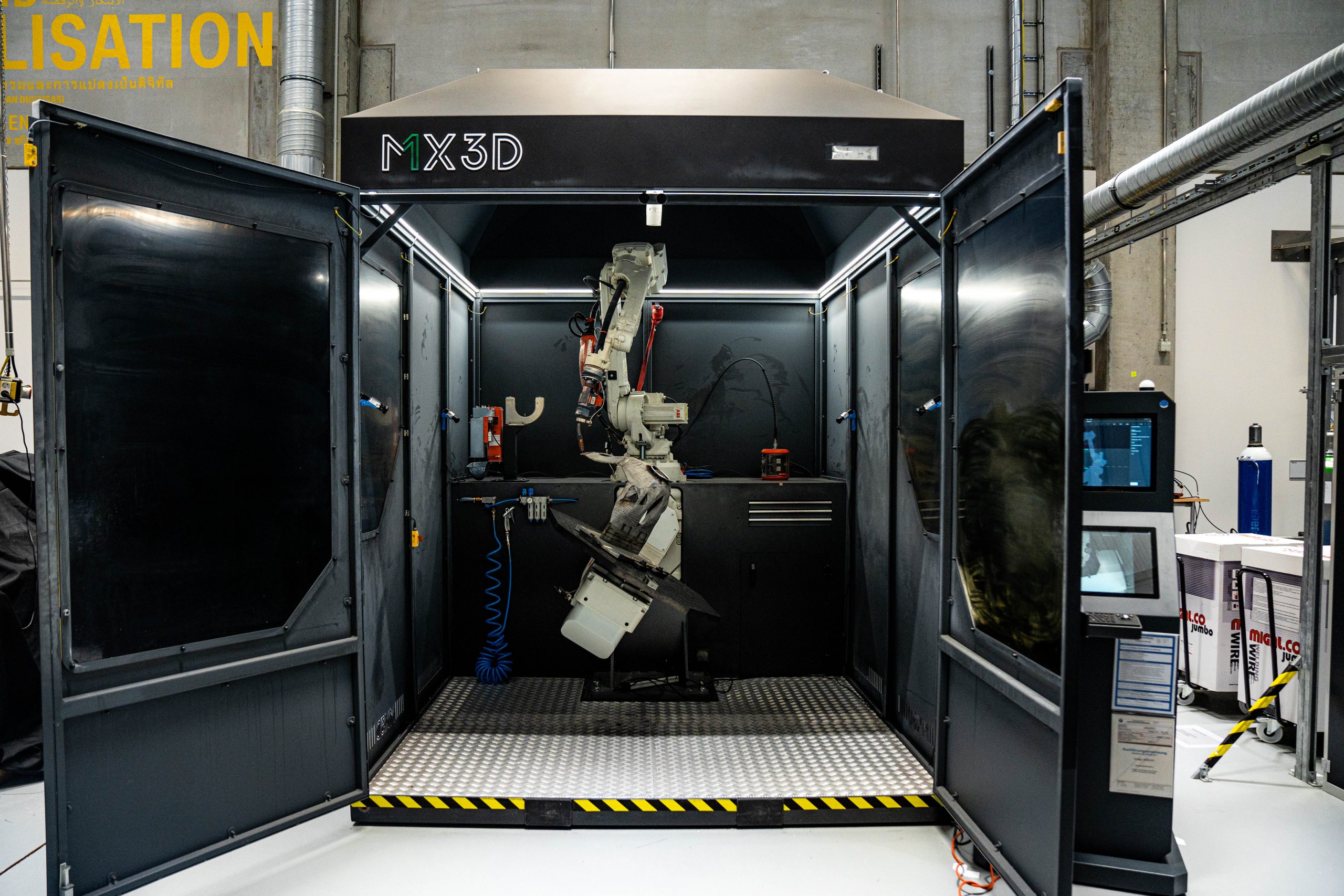
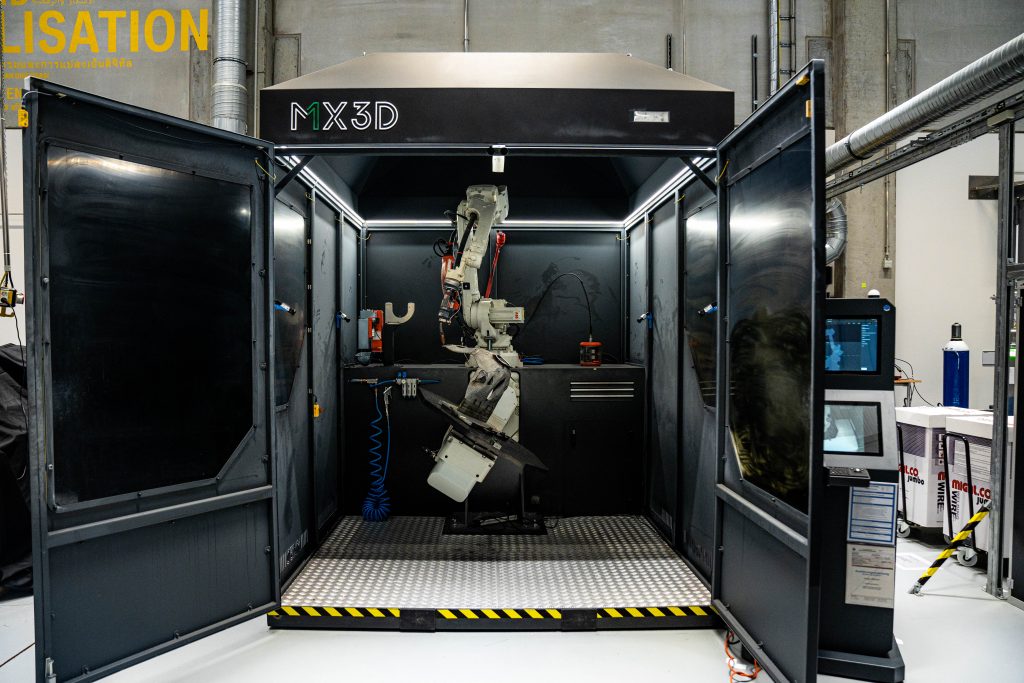
The BMW Group is trialling the process at the Additive Manufacturing Campus, where they have pooled production, research, and training in this area under one roof. BMW Group employees have been focussing on the DED process since 2015 and a DED cell from MX3D for the production of test components has been in use there since 2021. One of these example applications is the suspension strut support, which, in extensive testing on the test bench, is being compared with the series production component made from aluminium pressure die-casting.
“In this early stage it is already clear that the WAAM process can result in lower emissions in the production process. The lower weight of the components, their advantageous material usage ratio, and the option to use renewable energy means that the components can be produced more efficiently,” shared Jens Ertel, Head of BMW Additive Manufacturing.
The next stage of development on the road to series production is testing components in the vehicle, which will start in the foreseeable future.
The wider welding seams in the DED process mean that the surfaces of the components are not smooth, but slightly rippled and must be finished in critical areas. However, BMW Group engineers were able to demonstrate that DED components can be used for high loads, including cyclical loads, even without post-treatment of the surface. Optimised process parameters are crucial for ensuring durability directly from production, so the combination of welding process and robotic path planning must be coordinated optimally.

Configuration with generative design and algorithms
To make optimum use of the components produced in the DED process, the combination of the manufacturing process and a general new component design is paramount. To this end, the BMW Group continues to accelerate the use of generative design. Here, the computer uses algorithms to design optimised components based on the specific requirements. These algorithms are developed in close collaboration with interdisciplinary teams and are in part inspired by evolutionary processes in nature. As with bionic structures, the first step is to use only the material that is actually required for the topology of the component, and during fine-tuning in the second step, the component is reinforced only where necessary. This ultimately results in lighter and more rigid components as well as greater efficiency and improved vehicle dynamics.
“It’s impressive to see how WAAM technology has developed from research to become a flexible tool for not only test components but also series production components. The use of generative design methods enables us to make full use of design freedom and thus the potential of the technology. That was unthinkable just a few years ago,” stated Karol Virsik, Head of BMW Group Vehicle Research.
Production processes can complement each other
Different additive production processes are not necessarily in competition with each other, rather they should be viewed as complementary. For example, laser beam melting will continue to be more advantageous than the DED process when it comes to the highest level of detail resolution. In terms of the possible size of the component and the deposition rate, however, DED is said to be superior. The BMW Group is initially planning centralised DED production of components in Oberschleißheim, in the future, production at other locations and the use of the technology by suppliers is also possible. Further, it would even be conceivable to produce individual components directly on the assembly line using this process and to manufacture different parts without new tools, simply by changing the software. Sustainability can also be further improved by increasing the use of recycled metals.