Caltech researchers explore porosity control of copper-based alloys in Additive Manufacturing for spacecraft applications
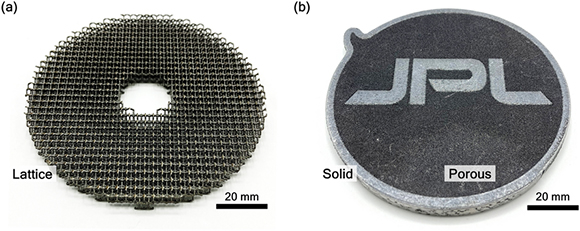
Researchers from the California Institute of Technology, Pasadena, USA, have published new research in the Journal of Porous Materials focused on a novel alternative technique to generate sub-millimetre-scale porosity in Laser Beam Powder Bed Fusion (PBF – LB) Additive Manufacturing using parameter-induced porosity. This technique has been demonstrated for iron, aluminium, titanium, and nickel-based alloys, but has not yet been explored for copper-based alloys.

To establish the requisite relationship between PBF-LB parameters, resultant porosity and material properties, the processing of copper, bronze, and brass samples were explored. Control of porosity was demonstrated with porosity bands of 23.5-47.9% for copper, 0.8-55.3% for bronze, and 8.0-50.2% for brass. Additional electrical and mechanical characterisation highlighted the influence of parameter selection and subsequent porosity on bulk material properties.
The full paper – ‘Porosity control of copper-based alloys via powder bed fusion Additive Manufacturing for spacecraft applications’ – is available here.