Green-laser DED Additive Manufacturing strengthens AA7075
MaterialsNewsResearch
November 6, 2026
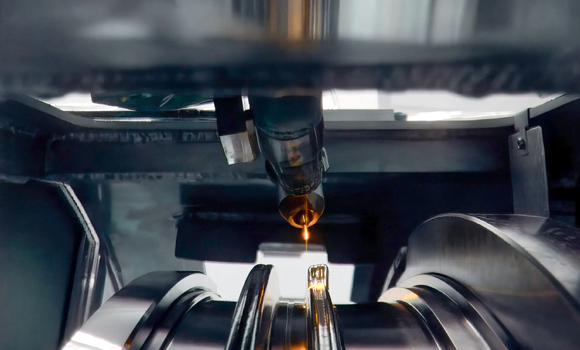
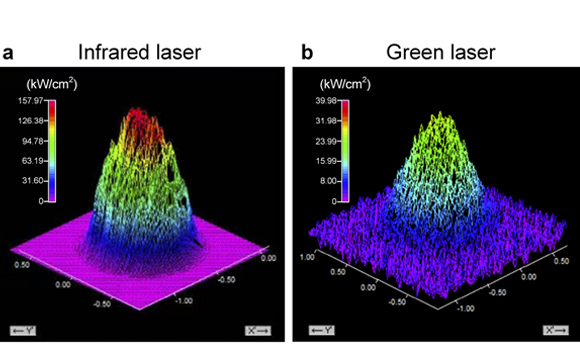
Focal-plane laser intensity distributions for (a) an infrared laser, showing a concentrated central peak, and (b) a green laser, showing a broader, more uniform distribution. The differences influence energy input and melt pool behaviour during Additive Manufacturing (Courtesy Liu, TS, et al., Nature Communications)

Researchers at Soochow University, China, together with Singapore’s Agency for Science, Technology and Research (A*STAR) and China’s Shanghai Jiao Tong University, Dongguan University of Technology and City University of Hong Kong, have developed a green-laser Directed Energy Deposition (DED) approach for processing high-strength AA7075 aluminium alloy. Following heat treatment, the researchers report achieving a tensile yield strength up to 591 MPa, exceeding the reference value for conventionally forged AA7075.

High-strength 7xxx-series aluminium alloys are challenging to process using conventional infrared laser Additive Manufacturing due to their low laser absorptivity and susceptibility to solidification cracking. The high processing temperatures required can also cause the evaporation of alloying elements, limiting the precipitation strengthening achievable through subsequent heat treatment.
To address these challenges, the researchers combined green-laser DED with a composite AA7075 powder containing embedded titanium carbide (TiC) nanoparticles. The shorter-wavelength green laser provided improved energy absorption, enabling deposition at lower laser powers than conventional infrared systems, while the TiC nanoparticles helped refine the grain structure and suppress cracking.

According to the study, the green laser also improved melt pool stability, reduced thermal gradients and limited the evaporation of alloying elements. This resulted in a more uniform grain structure with lower dislocation density.

Following T73 heat treatment, the deposited material developed a high density of nanoscale η′ precipitates and Guinier–Preston (GP) zones, reported at approximately 2.13 × 10¹⁶ m⁻². These strengthening features contributed to a tensile yield strength of up to 591 MPa.
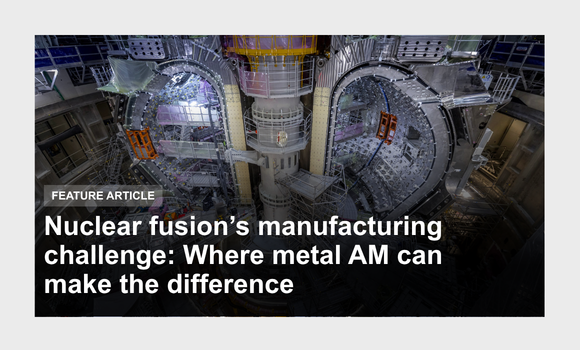
Nuclear Fusion’s Manufacturing Challenge Where Metal Additive Manufacturing Can Make The Difference

The researchers compared this result with a reported yield strength of 497 MPa for forged AA7075, as well as values for previously reported aluminium alloys processed by laser DED. However, the highest-strength specimens exhibited an elongation of approximately 2.9%, compared with 12.7% for the forged reference. Another green-laser processing condition achieved a yield strength of 543 MPa with 5.5% elongation, demonstrating a different balance between strength and ductility.

The researchers believe that combining short-wavelength lasers with modified powder feedstocks could provide a route to processing highly reflective, crack-susceptible alloys using Additive Manufacturing.

Ultrahigh strength aluminum alloy by green laser additive manufacturing, published in Nature Communications, is available here.
eng.suda.edu.cn

www.a-star.edu.sg

GET THIS ISSUE:  PDF  |  VIEW ONLINE  |  BUYER’S GUIDE
MaterialsNewsResearch
November 6, 2026

TRUSTED CONTENT. TARGETED AUDIENCE

Advertise with Metal AM and access a global base of 50,000+ AM professionals.

Contact Jon Craxford: [email protected]

Request a Media Pack
  • AM machines
  • Process monitoring & calibration
  • Heat treatment & sintering
  • HIP systems & services
  • Pre- & post-processing technology
  • Powders, powder production and analysis
  • Part manufacturers
  • Consulting, training & market data

Don’t miss a thing – register for our newsletter

Don't miss any new issue of Metal AM magazine, and get the latest industry news. Sign up to our twice weekly newsletter.

Register now

Join 40,000+ other AM professionals – follow us online

About Metal Additive Manufacturing magazine

Metal AM magazine, published quarterly in digital and print formats, is read by a rapidly expanding international audience.

Our audience includes component manufacturers, end-users, materials and equipment suppliers, analysts, researchers and more.

In addition to providing extensive industry news coverage, Metal AM magazine is known for exclusive, in-depth articles and technical reports.

Our focus is the entire metal AM process from design to application.

Each issue is available as an easy-to-navigate digital edition and a high-quality print publication.

Discover our magazine archive…

The free to access Metal Additive Manufacturing magazine archive offers unparalleled insight into the world of metal Additive Manufacturing from a commercial and technological perspective through:

  • Reports on visits to leading metal AM part manufacturers and industry suppliers
  • Articles on technology and application trends
  • Information on materials developments
  • Reviews of key technical presentations from the international conference circuit
  • International industry news

All past issues are available to download as free PDFs or view in your browser.

Browse the archive

Share via
Copy link
Powered by Social Snap