US Army completes flight test of additively manufactured heavy-fuel hybrid engine
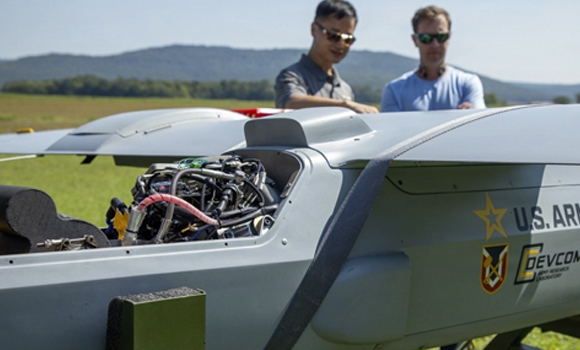
Researchers at the US Army Combat Capabilities Development Command (DEVCOM) Army Research Laboratory (ARL), Maryland, have successfully completed a flight demonstration of a heavy-fuel rotary-engine series-hybrid propulsion system incorporating additively manufactured components.
The series-hybrid propulsion system incorporates an integrated 400 V motor-generator and is designed to support vertical take-off and landing operations in contested environments.
DEVCOM ARL researchers used computational fluid dynamics modelling and a clean-sheet design approach to address how to efficiently burn heavy fuel in a rotary engine. The work is said to have improved fuel atomisation and vaporisation, while minimising compressed-air and fuel-vapour leaks.

“The use of advanced manufacturing, including 3D metal printing, allowed us to rapidly redesign engine components based on lessons learned through experimentation,” Dr Chol-Bum Kweon, DEVCOM ARL programme manager, said. “It enabled us to design an air-cooled engine that reduces propulsion-system size and eliminates the need for liquid coolant.”
Researchers developed the propulsion technology through the laboratory’s Versatile Tactical Power and Propulsion essential research programme, aiming to advance the capabilities of tactical unmanned aircraft.
“The programme addresses critical power and propulsion challenges by advancing fundamental science that could enable drones to fly longer and faster, operate at higher altitudes, carry heavier payloads and perform in extreme environments while reducing logistics burdens,” added Kweon. “For warfighters, the programme has transitioned research findings to industry partners for maturation and integration into capabilities that could enable mid-sized drones to operate beyond line of sight, extending the reach of ground commanders and reducing risk to Soldiers.”

To demonstrate the propulsion system in flight, DEVCOM ARL worked with industry partners, including Griffon Aerospace, to develop an aircraft platform around it. The series-hybrid propulsion system powers the Versatile Intelligence Controlled Tactical Operational Reconnaissance and Attack (VICTOR), a Group 3 medium-sized unmanned aircraft.