Researchers achieve ultra-high-strength AA7075 aluminium using green-laser Additive Manufacturing
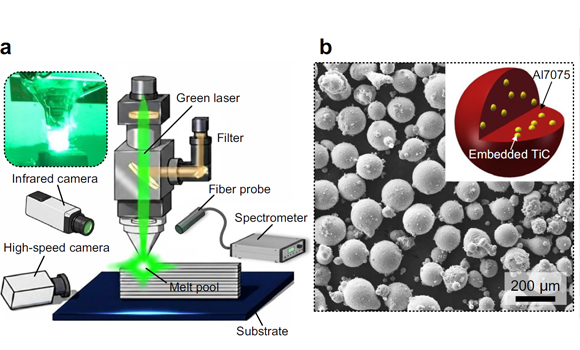
Researchers at Soochow University, China, and Singapore’s Agency for Science, Technology and Research (A*STAR) have reported a tensile yield strength of approximately 600 MPa in AA7075 aluminium alloy using green-laser Directed Energy Deposition (DED-LB) and titanium carbide (TiC)-reinforced powder.
The research, published in Nature Communications, reports yield strengths that exceed those of the forged AA7075 reference used in the study and almost all previously reported DED-processed aluminium alloys.
High-strength 7xxx-series aluminium alloys are difficult to process by laser-based Additive Manufacturing because of their high reflectivity, susceptibility to solidification cracking and evaporation of alloying elements such as zinc and magnesium.
To address these problems, the researchers combined a 532 nm green laser with AA7075 powder containing 1.7 wt.% TiC nanoparticles embedded within the aluminium particles.
The TiC particles promoted the formation of equiaxed grains and suppressed solidification cracking, while the green laser improved energy absorption and melt-pool stability. The researchers found that both were needed to produce high-density, crack-free deposits under the conditions investigated.
Compared with conventional infrared-laser DED, the green-laser process required less laser power. At the lower scan speed, high-density deposits were produced using 600 W, compared with 1,000 W for the infrared laser.
The green laser also reduced the evaporation of alloying elements, with zinc and magnesium losses falling by 30.1% and 77.2%, respectively, compared with infrared-laser processing. X-ray computed tomography showed a pore volume fraction of approximately 0.02%, compared with 0.11% for the infrared-laser specimens under the high-speed processing conditions.
Following T73 heat treatment, the low-speed green-laser specimens achieved a yield strength of 591 ± 22 MPa with 2.9 ± 0.5% elongation. Specimens produced at the higher scan speed achieved 543 ± 1 MPa with 5.5 ± 0.6% elongation.
The corresponding infrared-laser specimens recorded yield strengths of 345 ± 12 MPa and 411 ± 4 MPa, respectively.
Microstructural analysis showed that the improved retention of zinc and magnesium supported the formation of a high density of nanoscale η′ precipitates and Guinier–Preston (GP) zones during heat treatment, contributing to the increased strength.
The findings suggest that green-laser DED, combined with tailored powder compositions, could improve the processing of high-strength aluminium alloys that have proved difficult to manufacture using conventional infrared lasers.
The full paper can be accessed here.