ADAPT project advances metal Additive Manufacturing of titanium orthopaedic implants
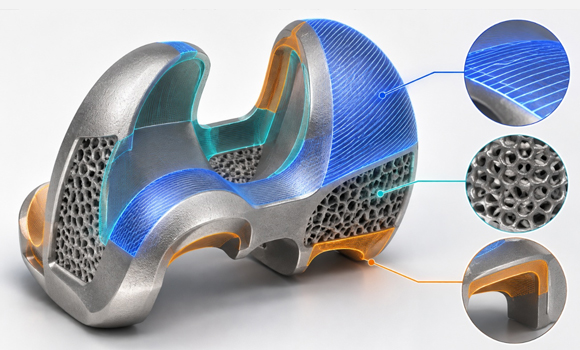
The ADAPT research consortium has reported first-year progress in the development and optimisation of Laser Beam Powder Bed Fusion (PBF-LB) for the production of customised titanium orthopaedic implants
Coordinated by Instituto de Soldadura e Qualidade (ISQ), the project involves collaboration with DISTech Disruptive Technologies GmbH, based in Kapfenberg, Austria, combining scientific research, digital manufacturing expertise and industrial process development. Research has focused on three areas: laser parameter optimisation, thermal process monitoring and the development of geometry-specific Additive Manufacturing strategies.
Laser parameter optimisation
During the first year of the project, experimental investigations were conducted using a range of titanium materials, including commercially pure titanium, Ti-6Al-4V ELI and Ti-5553.
DISTech additively manufactured a series of test specimens to investigate the influence of processing conditions on component quality. Parameters such as laser power, scanning speed, hatch distance and layer thickness influence material density, surface roughness, microstructure and defect formation. Particular attention was given to identifying suitable combinations of laser parameters and evaluating their effects on porosity, surface characteristics and process stability.
According to the blog post, the experiments provided an initial basis for establishing suitable processing windows and generated reference data for further optimisation, including the future processing of titanium powders produced through ultrasonic atomisation.
Thermal process monitoring
The project is also investigating the influence of component geometry on thermal behaviour during PBF-LB. Differences in heat conduction, local thermal mass and cooling conditions mean that geometrical features such as thin walls, thick sections, overhangs and porous structures can respond differently to identical process parameters.
DISTech used a high-speed infrared camera to monitor temperature distributions during the build process, focusing on test specimens featuring thin and thick wall sections. The research aims to establish how component geometry influences local heat accumulation and thermal behaviour.
Such investigations are particularly relevant to customised orthopaedic implants, which may incorporate thin structures, solid load-bearing sections and porous surfaces within a single component.
The findings are expected to support the development of improved process models and manufacturing strategies, with the aim of increasing process predictability and reducing defect formation.
Geometry-specific processing strategies
ISQ and DISTech are also investigating geometry-specific laser processing strategies, whereby individual regions of a component, such as thin walls, thick sections, overhangs and surface areas, are identified and assigned suitable laser parameters or scanning strategies.
During the project’s first year, existing software solutions and digital toolchains were evaluated to assess the feasibility of geometry-dependent parameter assignment. This work established an initial concept for more flexible laser exposure strategies, with further development and experimental validation planned.
ISQ is contributing its research coordination and digital manufacturing expertise, while DISTech is supporting the activities through its experience in PBF-LB, experimental manufacturing and process development.
The project ultimately aims to move away from conventional trial-and-error approaches towards more predictive and controlled metal Additive Manufacturing. By combining systematic parameter development, thermal process monitoring and geometry-specific laser strategies, the partners hope to reduce manufacturing defects, improve repeatability and minimise material and energy consumption.
The findings from the first year of the project will inform the upcoming experimental validation of geometry-specific processing strategies and the future production of customised titanium implant demonstrators.