Empa and AGH researchers achieve 98% density in MEX aluminium parts using wick debinding
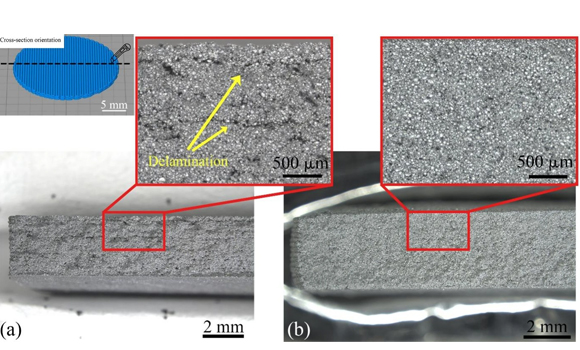
Researchers from the Swiss Federal Laboratories for Materials Science and Technology (Empa), Dübendorf, Switzerland, and AGH University of Krakow, Poland, have demonstrated that wick debinding can improve the sintered density of AA6061 aluminium alloy parts produced by Material Extrusion (MEX) Additive Manufacturing. The highest relative density achieved was approximately 98%, following an extended sintering cycle.
The study, published in Progress in Additive Manufacturing, investigated the suitability for AM, debinding behaviour and sinterability of aluminium-based feedstocks prepared using three commercially available thermoplastic binder compositions. Particular attention was given to the influence of debinding methods on the microstructure and densification of the sintered parts.
Two debinding approaches were compared: conventional solvent debinding followed by thermal debinding, and a single-step wick debinding process in which green parts were embedded in a porous alumina powder bed. The latter method enables binder removal through capillary action without requiring a preliminary solvent treatment.
Debinding presents particular challenges for aluminium-based feedstocks because of the material’s susceptibility to oxidation. This restricts the choice of solvents and the temperatures that can be used during thermal debinding in air. Oxidation can inhibit particle bonding during subsequent sintering, limiting the density of the finished components.
Thermogravimetric analysis established that oxidation of the AA6061 aluminium powder began at approximately 400°C. The researchers therefore selected thermal debinding temperatures below 400°C to minimise oxidation during binder removal.
Both debinding approaches achieved binder removal of at least 96% under optimised conditions, although performance varied with the binder system and processing temperature. However, optical microscopy and density measurements indicated that solvent debinding, even when using high-purity acetone, was associated with slight oxidation, particularly at the surfaces of the printed samples, and lower densities following sintering.
In comparison, wick debinding without prior solvent treatment produced samples with higher sintered densities and more uniform microstructures. For samples prepared using the Kcmix binder system, a relative density of 96.7% was achieved following sintering at 635°C for 2 h, compared with approximately 94% for samples processed using solvent and thermal debinding.
The researchers also examined the influence of sintering dwell time. Increasing the holding period from 2 h to 10 h improved the relative density of the wick-debound Kcmix samples from 96.7% to 97.9%. Samples prepared using the alternative EnCeram binder system reached 96.8% relative density after the longer sintering cycle.
The findings highlight the importance of debinding conditions in achieving high-density aluminium components through material extrusion Additive Manufacturing. The researchers concluded that carefully controlled wick debinding, combined with extended sintering times, could offer a suitable route for processing AA6061 feedstocks containing commercial thermoplastic binders.
Further research will be required to evaluate the mechanical properties of the sintered parts and establish their suitability for industrial applications.
‘Material extrusion-based additive manufacturing of aluminum feedstocks with a focus on the debinding process’ is available here.