Researchers develop multi-scale model of sintering anisotropy in BJT stainless steel parts
MaterialsNewsResearch
October 26, 2026
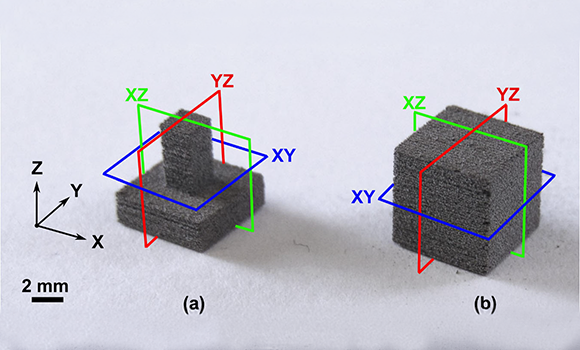
Binder-jetted 316L stainless steel specimens used to investigate anisotropic shrinkage during sintering. The coloured planes indicate the orientations analysed in the study. (Courtesy Grippi et al./npj Advanced Manufacturing)

Researchers from San Diego State University, California, USA, have published research in npj Advanced Manufacturing on the development of a multi-scale modelling framework to investigate anisotropy during the sintering of 316L stainless steel parts produced by Binder Jetting (BJT).

Conducted in collaboration with Eindhoven University of Technology, the Netherlands, and Clemson University, South Carolina, USA, the study combines kinetic Monte Carlo (kMC) simulations with Finite Element (FE) modelling to investigate how directional differences in material behaviour develop during sintering.
Sinter-based Additive Manufacturing: Beyond the hype, towards industrial success

The researchers first calibrated and validated a mesoscale kMC sintering model using X-ray computed tomography (CT), discrete element modelling and optical microscopy. Interrupted thermal cycles enabled the team to examine microstructural changes at different stages of densification.

Following validation, the mesoscale model was used to determine characteristics such as strain rate and pore orientation. These were subsequently incorporated as anisotropic sintering stress inputs into a larger-scale continuum model, based on the Skorohod-Olevsky Viscous Sintering (SOVS) framework.

Developed specifically for 316L stainless steel, the continuum model accounts for several factors influencing sintering behaviour, including initial relative density, grain growth kinetics, the formation of δ-ferrite at elevated temperatures, friction and gravity.
By combining experimental imaging, tensor-based analysis and numerical simulations, the researchers were able to connect directional variations at the mesoscale with the overall sintering response of a component.

The results indicate that anisotropy evolves nonlinearly across different structural scales, highlighting the importance of accounting for microstructural behaviour when modelling sintering at the component level.

The research suggests that coupling models across different scales could support a more comprehensive understanding of anisotropic shrinkage and deformation during the sintering of binder-jetted metal components.

The paper, ‘Continuum meso-macro multiscale modeling of anisotropy during sintering of parts produced via additive manufacturing’, is available here.
www.sdsu.edu

www.tue.nl/en/

www.clemson.edu

GET THIS ISSUE:  PDF  |  VIEW ONLINE  |  BUYER’S GUIDE
MaterialsNewsResearch
October 26, 2026

TRUSTED CONTENT. TARGETED AUDIENCE

Advertise with Metal AM and access a global base of 50,000+ AM professionals.

Contact Jon Craxford: [email protected]

Request a Media Pack
  • AM machines
  • Process monitoring & calibration
  • Heat treatment & sintering
  • HIP systems & services
  • Pre- & post-processing technology
  • Powders, powder production and analysis
  • Part manufacturers
  • Consulting, training & market data

Don’t miss a thing – register for our newsletter

Don't miss any new issue of Metal AM magazine, and get the latest industry news. Sign up to our twice weekly newsletter.

Register now

Join 40,000+ other AM professionals – follow us online

About Metal Additive Manufacturing magazine

Metal AM magazine, published quarterly in digital and print formats, is read by a rapidly expanding international audience.

Our audience includes component manufacturers, end-users, materials and equipment suppliers, analysts, researchers and more.

In addition to providing extensive industry news coverage, Metal AM magazine is known for exclusive, in-depth articles and technical reports.

Our focus is the entire metal AM process from design to application.

Each issue is available as an easy-to-navigate digital edition and a high-quality print publication.

Discover our magazine archive…

The free to access Metal Additive Manufacturing magazine archive offers unparalleled insight into the world of metal Additive Manufacturing from a commercial and technological perspective through:

  • Reports on visits to leading metal AM part manufacturers and industry suppliers
  • Articles on technology and application trends
  • Information on materials developments
  • Reviews of key technical presentations from the international conference circuit
  • International industry news

All past issues are available to download as free PDFs or view in your browser.

Browse the archive

Share via
Copy link
Powered by Social Snap