Flying Ray challenges the traditional scanner set-up in powder bed fusion
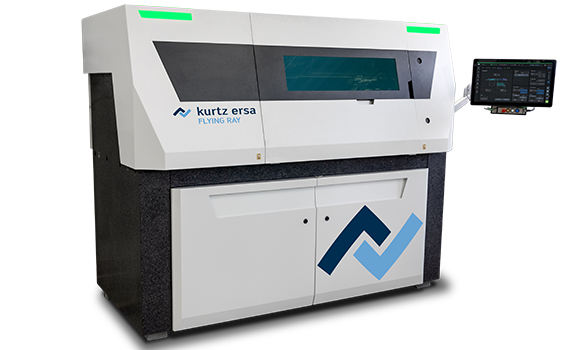
At Formnext 2026, Kurtz Ersa, headquartered in Kreuzwertheim, Germany, will showcase Flying Ray® S, a Laser Beam Powder Bed Fusion metal (PBF-LB/M) AM machine with a build volume of 250 × 250 × 350 mm, developed around a different approach to laser beam delivery. Instead of directing the laser across the powder bed from a fixed scan head, the Flying Ray Pivot moves the optics across the build area. The approach is designed to maintain consistent conditions under which the laser strikes the powder bed, regardless of where a part is positioned. Kurtz Ersa aims to address build-position dependency through the machine architecture itself, rather than compensating for it afterwards. The objective is to provide a stronger foundation for quality, process transfer and qualification at an industrial scale.
Reducing build-position dependency
For metal Additive Manufacturing production, the challenge is not simply whether a part can be produced, but whether a process can be qualified, transferred and relied upon. Quality must be maintained across the build area, from job to job and from machine to machine. This is particularly important for high-value components in regulated or safety-critical industries. Powder condition, gas flow, heat management, calibration and software can all affect the result, adding development, inspection and documentation requirements.
Flying Ray was developed around the principle of eliminating sources of process variation where possible, rather than compensating for their effects.
Fixed-point beam deflection creates position-dependent geometry
Conventional PBF-LB/M machines use a stationary scanner to direct the laser across a defined field. As the beam moves away from the central axis, its angle of incidence changes and the spot becomes elliptical. The conditions in the interaction zone therefore differ from those at the centre. Calibration and parameter adjustments can reduce these effects, but the underlying laser-powder interaction still varies with position.
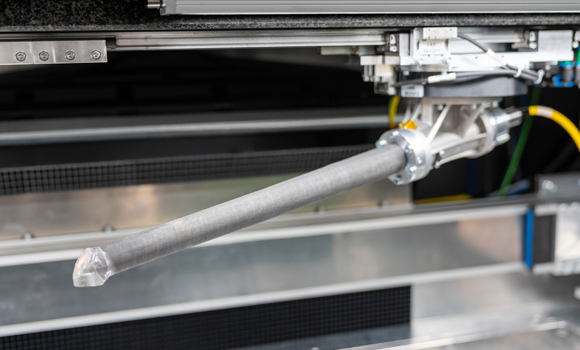
Flying Ray changes which element moves. The Pivot concept combines linear and rotational motion to carry the beam-deflection unit across the build area. Rather than reaching the entire platform through progressively greater beam deflection from a fixed point, the beam-delivery unit moves with the working position. The design principle is to maintain a constant angle of incidence across the build platform. According to Kurtz Ersa, this is intended to ensure that the laser-powder interaction remains consistent as the working position changes.
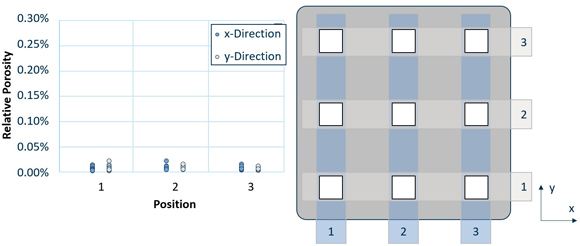
Flying Ray retains the fundamental requirements of PBF-LB/M, but its architecture is designed to eliminate one source of position-dependent variation. This is expected to reduce the need for position-specific corrections and improve the consistency of energy delivery, melt-pool behaviour, surface characteristics and part properties across the usable build area.
Moving optics requires control of the process chain
Moving the beam-deflection unit presents an engineering challenge: positioning a significant moving mass with the dynamics and precision required for PBF-LB/M. The Flying Ray Pivot combines a stiff structure, optimised inertia distribution and advanced motor technology to balance dynamic movement with accurate path execution.
Flying Ray S also integrates optimised gas flow, in-situ monitoring and traceable error logging.
Software is another important element. Fuse-IQ, Kurtz Ersa’s in-house build processor, converts sliced geometry into exposure paths. Path planning, trajectory calculation and machine control are also developed in-house to match the moving mechanics, giving the company control of the process chain from build path to machine movement.
The Flying Ray S MultiHead configuration treats the optional second laser as more than a throughput multiplier. When two heads contribute to the same part, the transition between them becomes critical. Processing rules are being developed for overlap, sequence and timing, with the aim of achieving a visually seamless and process-stable transition. This work remains ongoing, but it demonstrates how closely mechanics, software and melt-pool behaviour must be developed together.
As an R&D partner, the Computational Manufacturing group at ETH Zurich contributes simulation and modelling expertise to Flying Ray. For Mamzi Afrasiabi, who leads the group, the team’s ambition became tangible during a visit to Kurtz Ersa in Kreuzwertheim: “I’ve been closely engaged with Additive Manufacturing for more than a decade, from several different perspectives and across various aspects of the process. So I’m familiar with the complexity behind it — the dynamics, the control challenges, and the constant effort to avoid defects. When I first entered the lab and saw the machine, it was a real shock… in a genuinely impressive way! What stood out to me was the ambition of the team: they are not simply refining an established solution, but building something from the ground up and tackling the fundamental technological challenges head-on.”
Flying Ray S forms the basis of a larger machine family
Flying Ray S is intended as the entry platform in a larger machine family. The development goal is to retain its defining technical characteristics in machines with larger build areas, allowing processes developed on the smaller platform to be transferred without restarting development. This transferability remains to be demonstrated as the machine family expands.
Flying Ray cannot eliminate every source of process variation. Powder, gas flow, recoating, calibration and software remain important. Its contribution is focused on addressing one source of position-dependent beam geometry through the machine architecture.
For Kurtz Ersa, the wider industrial objective is to establish repeatable processes that can be transferred to larger machine configurations without introducing additional variability.
Flying Ray S will make its world premiere at Formnext 2026 with a build volume of 250 × 250 × 350 mm and a 400 W fibre laser. A second laser is available as an option. The machine will initially support stainless steel 316L, with Inconel and titanium alloys intended to follow.
Visit Kurtz Ersa at Formnext in Hall 12.0, Stand C31.