POSTECH AI control reduces simulated PBF-LB defects
Researchers from Pohang University of Science and Technology have published a paper in Journal of Intelligent Manufacturing focusing on an AI-assisted control system designed to reduce defects in Laser Beam Powder Bed Fusion (PBF-LB) Additive Manufacturing.
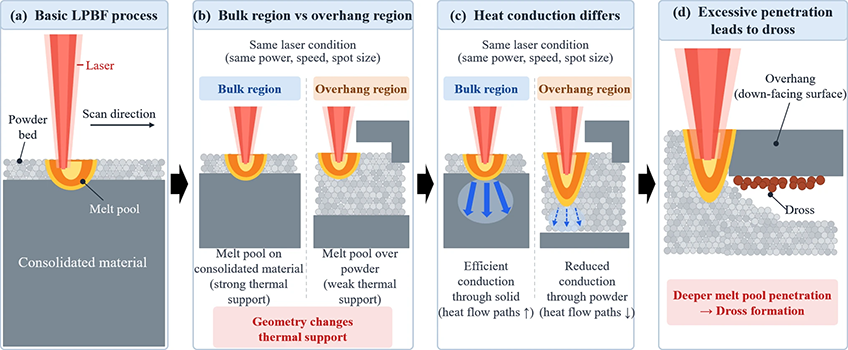
The research addresses challenges associated with manufacturing overhanging features, where reduced thermal support can lead to excessive heat build-up and dross formation. Reducing laser power can help prevent this, but may also cause insufficient melting, resulting in lack-of-fusion defects.

To address this, the researchers proposed a neuro-symbolic control system that combines AI-based predictions with structured manufacturing knowledge to adjust laser power according to the geometry being built.
The simulated controller uses melt-pool width feedback, while a neural-network ensemble estimates the geometry- and power-dependent depth-to-width ratio. A knowledge-based reasoning system then identifies the relevant quality limits for each geometric feature, allowing the controller to adjust laser power while balancing the risks of dross and lack of fusion.
The researchers evaluated the approach through simulations using a PBF-LB thermal model calibrated against benchmark data for IN625 nickel alloy.
At a 45° overhang angle, the proposed system reduced the average number of tracks classified as defective from 6.0–6.2 for the geometry-conditioned comparison methods to 3.2 per simulated build. Unlike these methods, which largely prevented dross but introduced lack-of-fusion defects, the proposed system avoided this systematic shift between defect types.
The researchers also demonstrated how the structured knowledge model could make process constraints easier to define, interpret and extend to different manufacturing conditions.
However, the authors emphasised that the findings are based on simulations rather than physical PBF-LB trials. The system’s performance also depends on accurately estimating the relationship between melt pool depth and width.
Future work will focus on validating the approach using an instrumented PBF-LB Additive Manufacturing machine with melt pool monitoring, followed by inspections of manufactured parts. Potential applications include components with complex geometries, such as internal channels and lattice structures, where thermal conditions vary throughout the build.
‘Ontology-enabled neuro-symbolic closed-loop control of laser powder bed fusion’ is available here.