RMIT uses infrared data and machine learning to assess DED builds
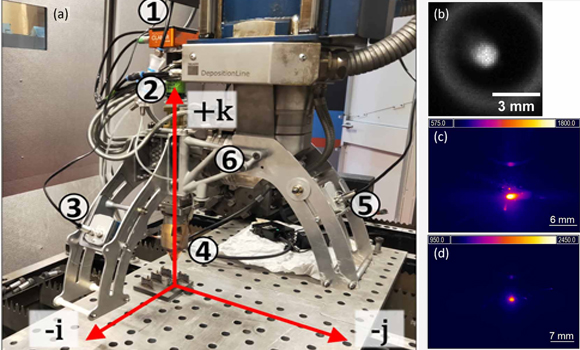
Researchers at RMIT University, Melbourne, Australia, have published a study in Journal of Physics: Photonics investigating the use of multi-axis infrared process monitoring and machine learning to assess build conditions during Laser-Beam Directed Energy Deposition (DED-LB) Additive Manufacturing.
The research uses time-sequenced infrared process-monitoring data as input for long short-term memory (LSTM) neural networks. Rather than assessing individual measurements in isolation, the approach uses temporal information contained in the continuous DED process.

The researchers investigated both single-source and multi-source infrared data. According to the paper, the multi-source LSTM models were able to predict build conditions including bulging, depression, porosity and over- or under-building. The study reports F1 scores exceeding 0.95, with inference times of 2 ms for each 0.5 s observation window.
The authors state that the combination of in situ monitoring and contextual machine learning could enable rapid interpretation of process-monitoring data both offline and in-line. The approach may also support the future development of feedback control during metal Additive Manufacturing.

The research builds on previous work involving the RMIT Centre for Additive Manufacturing and CSIRO Manufacturing into multi-axis infrared monitoring for DED, including the detection of process-induced porosity and other structural features during deposition.
‘Multi-axis infrared process monitoring with contextual machine learning for inspecting build-condition in laser directed energy deposition’ is available here.