Ames National Laboratory adds high-temperature refractory metal powder atomiser
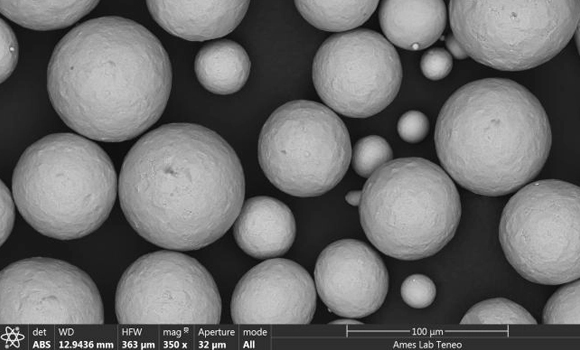
The US Department of Energy’s Ames National Laboratory has installed a new refractory metal powder atomiser capable of processing materials at temperatures up to 3,400°C, with production rates of up to 1 kg per minute.
The atomiser will support the development of materials for extreme-temperature applications, including gas turbines and fusion energy systems.
“Ames Lab has a long history of making specialized powders that other places simply can’t,” stated Ames Lab Scientist Jordan Tiarks. “This system builds on that foundation but pushes us into a new temperature and materials regime that’s been largely out of reach.”
Refractory metals such as tungsten, molybdenum, niobium and vanadium have high melting points and can be used to develop alloys capable of operating at temperatures beyond conventional nickel- and cobalt-based superalloys. However, these materials can be difficult to process into complex components using conventional manufacturing methods.
Powder-based manufacturing offers an alternative, but the availability of suitable powders has been a challenge. The new atomiser is intended in part to support the Department of Energy’s Advanced Research Projects Agency-Energy (ARPA-E) ULTIMATE programme, which is developing ultra-high-temperature materials for next-generation gas turbines.
According to Ames Lab, researchers developing new alloys under the programme have experienced difficulties obtaining powders in the quantities and quality required for testing and validation.
The new atomiser uses a transferred arc plasma process, in which high-energy plasma locally melts feedstock before atomisation. Feedstock can include bars and chunks, provided the composition is consistent throughout.
Melting takes place in a water-cooled copper hearth, where a layer of solidified material forms a protective ‘skull’ between the molten material and copper. Only a small volume is molten at any one time, reducing exposure to high temperatures and helping control purity and reactivity.
Researchers are currently training on the atomiser using commercial titanium alloys and will subsequently process materials including molybdenum and nickel-based superalloys.
The atomiser will then be used to produce powders for research into next-generation turbine components, fusion energy systems and other extreme-environment applications. This includes Ames Lab’s collaboration with Pacific Northwest National Laboratory on structural materials for fusion energy systems.
The refractory atomiser complements Ames Lab’s existing induction and close-coupled atomisers. These can achieve yields of 50–60% within the target particle-size range, compared with around 10–20% for high-temperature alloys processed using the refractory atomiser.
“One of our long-term goals is to take what we’ve learned over decades of atomization and apply it to this new class of equipment,” Tiarks added. “We want to improve yields, develop smart recycling strategies for off-size powders, and help push the industrial state of the art forward for ultra-high-temperature materials.”
The atomiser was funded through ARPA-E’s ULTIMATE programme.