Fraunhofer develops fatigue prediction tool for metal AM
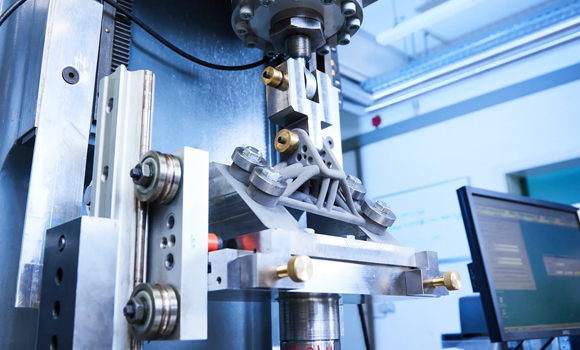
Researchers from the Fraunhofer Institute for Mechanics of Materials (IWM), Freiburg, Germany, have developed a model-based calculation chain for predicting the effects of mechanical surface post-processing on the fatigue performance of additively manufactured metal components, enabling engineers to select and optimise post-treatment strategies before physical testing.
Additively manufactured metal components offer significant design freedom and opportunities for customisation. However, their adoption in safety-critical sectors such as aerospace, automotive and energy has been limited by concerns over fatigue performance. Surface roughness, tensile residual stresses and process-induced defects, including gas porosity and lack-of-fusion defects, can act as crack initiation sites, leading to premature component failure.

The Fraunhofer researchers have developed a model-based calculation chain that predicts the effect of mechanical surface post-processing on the fatigue strength of metal AM components. The work addresses the lack of a practical engineering model for selecting and validating post-processing methods such as shot peening, deep rolling and burnishing, which are used to increase surface hardness, reduce defect density and introduce beneficial compressive residual stresses.
Developed through a project funded by Germany’s Federal Ministry for Economic Affairs and Energy (BMWE), the calculation chain was validated using AlSi10Mg, 316L stainless steel and Ti6Al4V components produced by Laser Beam Powder Bed Fusion (PBF-LB) and Cold Metal Fusion (CMF).
The workflow combines three stages:
Component assessment and process selection: **Depending on the component geometry and the location of the highest stress, the appropriate post-treatment method is determined.
Process simulation: Surface layer properties such as residual stresses, roughness, and hardening are predicted and optimised as a function of the process parameters (eg peening pressure, contact force, path overlap).
FKM-based fatigue life assessment: The fatigue life prediction is carried out in accordance with the FKM guidelines established among design engineers and SMEs and can be directly integrated into existing development processes. The FKM fatigue life assessment was adapted for the additively manufactured and post-treated materials AlSi10Mg, 316L, and Ti6Al4V.
According to Fraunhofer IWM, experimental validation at both specimen and component levels demonstrated increases in fatigue strength of up to 40%, together with significant improvements in predicted service life.
“One significant reason why post-treatment methods are rarely used for AM components is the lack of understanding of the effect chain from process parameters to service life improvement, and the absence of a fatigue life verification method. With our approach, we are now opening new possibilities for novel applications,” Fraunhofer stated.
Fraunhofer added that the methodology can be applied during the early stages of product development, enabling engineers to compare different post-processing strategies computationally before manufacturing and testing physical components. Because fatigue failures typically initiate at the surface, the institute states that tailored surface treatment can also help compensate for process-related variability in metal AM production. Furthermore, the approach is designed to be transferable to additional materials using fundamental mechanical properties such as yield strength and tensile strength.
Fraunhofer IWM describes the development as the first computer-aided design methodology specifically intended for the mechanical surface post-processing of additively manufactured metal components.