Nikon SLM Solutions and Bosch produce single-piece AM V8 engine block
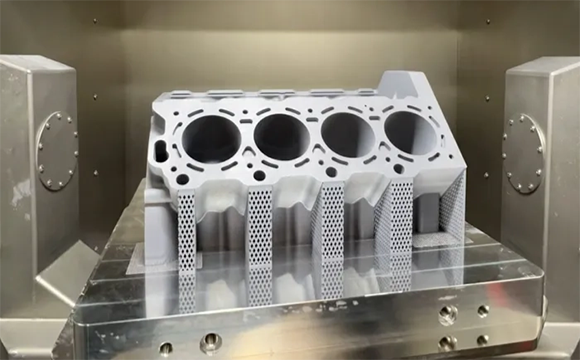
Nikon SLM Solutions, Lübeck, Germany, and Bosch Industry Consulting, Stuttgart, have collaborated to manufacture a complete aluminium V8 engine block as a single component at the Bosch Additive Solution Center in Nuremberg. The component was produced in AlSi10Mg on an NXG XII 600 Laser Beam Powder Bed Fusion (PBF-LB) Additive Manufacturing machine.
Although developed as a technology demonstrator, the engine block illustrates how large-format AM is advancing beyond prototyping towards applications traditionally produced by conventional manufacturing processes, particularly in automotive.
The automotive sector relies heavily on Tier 1 and Tier 2 suppliers, which manufacture an estimated 60-80% of vehicle components. As a result, broader adoption of AM will depend not only on investment by original equipment manufacturers (OEMs) but also on implementation throughout the supplier network.
The collaboration combines Bosch Industry Consulting’s experience in automotive manufacturing with Nikon SLM Solutions’ experience in metal Additive Manufacturing technology, application engineering and process development to support the qualification of AM for production applications.
Introducing AM into a production environment involves considerably more than installing new equipment. Successful implementation requires expertise in materials qualification, process parameter development, Design for Additive Manufacturing (DfAM), software integration, quality assurance and application engineering to establish repeatable manufacturing processes.
The V8 engine block highlights several advantages of metal AM. Conventional cylinder block production typically requires dedicated tooling that can take weeks or months to design, manufacture and validate before production begins. Design revisions often require further tooling modifications, increasing development time and cost, while casting also imposes geometric constraints.
AM, by comparison, produces components directly from digital model data without dedicated tooling. This shortens development cycles and enables complex internal geometries, including integrated cooling channels, topology-optimised structures and consolidated assemblies that would be difficult or uneconomical to produce using conventional casting methods.
The technology also enables weight reduction by applying DfAM principles to place material only where it is structurally required. This can reduce component mass while maintaining mechanical performance, making the approach attractive for high-performance automotive and motorsport applications.
For the project, Nikon SLM Solutions supplied the NXG XII 600 Additive Manufacturing machine together with support for materials qualification, process parameter optimisation, build preparation software, quality assurance and application engineering.
Producing a large, geometrically complex aluminium engine block as a single component required process parameters tailored to both the AlSi10Mg alloy and the part geometry, together with robust DfAM and quality assurance procedures to verify build integrity throughout production.
Bosch Industry Consulting contributed automotive manufacturing expertise to assess how the demonstrator could be translated into repeatable industrial manufacturing processes.
www.bosch-industry-consulting.com