AMPERA unveils additively manufactured reactor module
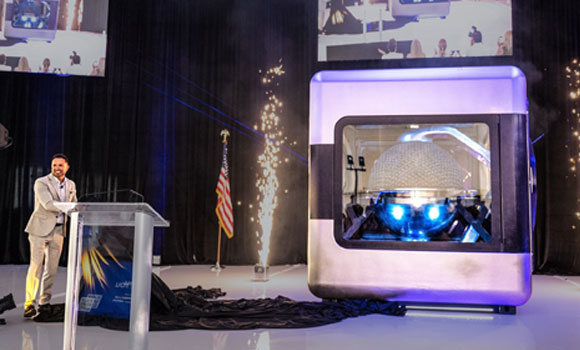
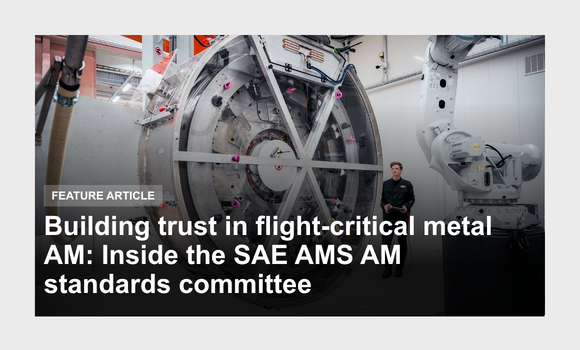
AMPERA, based in Palm Beach Gardens, Florida, has completed production of what it states is the first full-scale, additively manufactured nuclear reactor module. The company is reportedly developing the world’s first subcritical, solid-state, factory-built thorium nuclear reactor.
This first nuclear module unit, which includes the core and pressure vessel, was unveiled yesterday at AMPERA’s innovation centre with more than 100 local officials, business leaders and employees, in attendance.
“This next-generation nuclear core and pressure vessel sets the foundation for factory-built, mass-produced nuclear energy,” said Brian Matthews, Founder and CEO of AMPERA. “The advanced technology and Additive Manufacturing used demonstrate a clear commercial path for new nuclear technology coming to market in an accelerated manner.”
AMPERA’s spherical monolithic gyroid core is additively manufactured with silicon carbide and designed for up to 30 years of life without refuelling. The company’s advanced nuclear energy systems are fuelled with tri-structural isotropic (TRISO) thorium kernels. In June, AMPERA announced that it had established an Australian subsidiary to secure thorium supply and support US advanced nuclear fuel production.
According to the company, its modular nuclear systems are built with inherent stability by design. Safety is achieved through core design and physics characteristics, reducing reliance on active systems and operator intervention. AMPERA’s nuclear systems are expected to provide up to 30 MWe of power, with larger configurations planned.
Last week, AMPERA announced what it calls its “Power Now. Nuclear Next.” strategy, introducing its proprietary Integrated Energy Architecture, designed to deliver ultra-high-efficiency power generation solutions today through waste heat recovery and conventional-fuelled power generation. These modular, gas-powered systems leverage AMPERA’s proprietary supercritical carbon dioxide technology and are two-thirds common with the nuclear configuration.
“Our reactors are built for the markets that need power the most: AI data centres, defence, industrial and maritime,” Matthews said. “We expect to be the first company to industrialise factory-built nuclear power with near-term deployment timelines.”