Meltio case study highlights DED success at ExxonMobil refinery
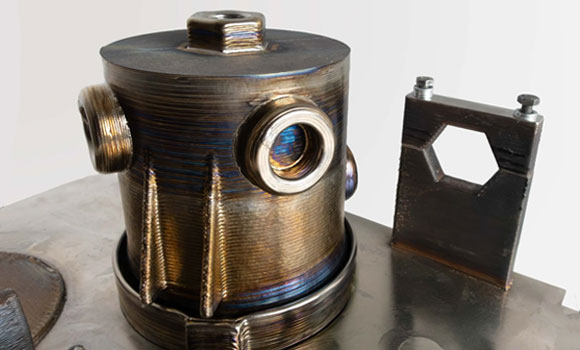
Meltio, headquartered in Linares, Spain, has published a case study examining the transition from traditional manufacturing to its Laser Metal Deposition (LMD) technology, a laser-based wire Directed Energy Deposition (DED) process, at ExxonMobil’s Baton Rouge refinery in Louisiana, USA.
In addition to the use of AM, the project also demonstrated the viability of titanium for refinery applications. It was stated that ExxonMobil had not previously considered titanium components due to cost, however, the company found that Meltio’s Additive Manufacturing technology offered a cost-effective production route without compromising component quality or performance.
The final solution centred on the redesign of a protective anti-wicking device used in refinery equipment. The redesigned component delivered both structural improvements and significant cost savings.
Identifying the bottleneck and moving to Ti-6Al-4V
The existing anti-wicking device, designed to prevent oil from wicking along thermocouple wires into an instrument cabinet, presented a number of design and operational limitations.
The first step was to replace the original material with a more suitable alternative. Following the evaluation of several candidates, Ti-6Al-4V was selected because it offered reduced weight, lower overall production costs and was already qualified for use with Meltio’s Additive Manufacturing technology.
However, adapting the component for metal Additive Manufacturing introduced several metallurgical and operational challenges.
- Atmosphere control: Ti-6Al-4V requires a strictly inert environment to achieve the desired microstructure and material properties. Establishing this atmosphere required approximately ninety minutes of machine preparation time to remove oxygen before production could begin.
- Thermal management: The material required a minimum layer time of seven minutes to prevent overheating, making single-part production inefficient because of extended idle periods between deposited layers.
- Deposition challenges: Initial production trials revealed surface oxidation caused by localised heat accumulation, together with excess material deposition on the lateral clamping wings. Rapid travel movements also caused the unsupported component to shift during the build process, resulting in a loss of laser focus.
“Refinery equipment has to survive extreme conditions and constant vibration,” Meltio explained. “By redesigning the component and locking it firmly in place during the printing process, we created a solid, leak-proof titanium barrier that easily meets the strict reliability standards required by ExxonMobil.”
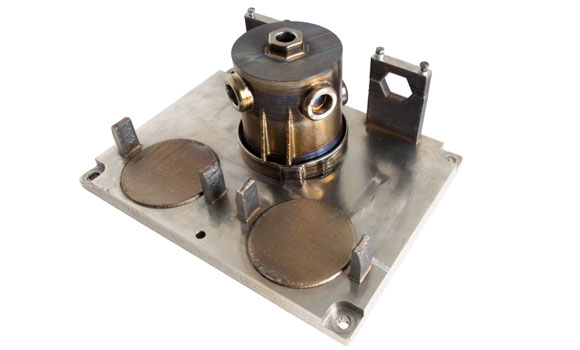
Applying metal Additive Manufacturing through fixture and process optimisation
Engineering teams used the Meltio M600 Additive Manufacturing machine to redesign the component specifically for three-axis production.
To improve inert-gas utilisation within the build chamber, engineers additively manufactured a custom fixture from SS-316LSi on an SS304 baseplate. The fixture enabled the simultaneous production of four components, increasing inter-layer dwell times and eliminating the surface oxidation observed during earlier trials.
Deposition strategy and process parameter optimisation
The main body was redesigned with a maximum overhang angle of 75°. To avoid the need for support structures, the team adopted a non-planar deposition strategy. Using the M600’s probing functions, the machine performed a Z-axis touch-off at the lowest point of the substrate, allowing features to be deposited directly onto a curved surface.
The lid was also redesigned to include hollow perimeter features intended to accommodate a silicone sealant.
Material overgrowth was reduced by lowering laser power and deposition speed in selected regions of the component. To prevent movement during non-deposition travel motions, mechanical clamps were added to both sides of the fixture, securing the components throughout the build process.
Validating DED for oil and gas applications
According to the case study, the replacement of CNC machining with DED Additive Manufacturing for Ti-6Al-4V components enabled greater design optimisation while delivering measurable economic benefits. By addressing the material’s thermal behaviour and implementing a batch-production approach, ExxonMobil Baton Rouge successfully redesigned and manufactured a critical protective component.
According to the company, the resulting process reduced unit costs by 42%, demonstrating the potential of DED as a competitive manufacturing solution for demanding oil and gas applications.
“Moving away from traditional machining completely changed our production economics. We cut unit costs by 42% and shrank our lead times from six weeks to just under sixty hours, proving that Additive Manufacturing delivers real financial value to the oil and gas industry,” ExxonMobil concluded.
The full case study can be read here.