Study explores Additive Manufacturing of copper-coated diamond composites
MaterialsNewsResearch
April 23, 2026
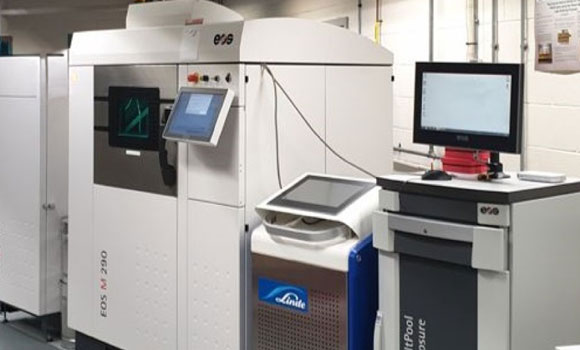
The EOS M290 metal Additive Manufacturing machine used to carry out single track and multi-track experiments (Courtesy https://doi.org/10.1016/j.diamond.2026.113591)

Researchers from the UK’s University of Wolverhampton and Diamond Hard Surfaces Ltd, based in Towcester, as well as the College of Engineering, Prince Mohammad Bin Fahd University, Al-Khobar, Saudi Arabia, have published research in Diamond and Related Materials that demonstrated the processing of copper-coated diamond via Laser Beam Powder Bed Fusion (PBF-LB) Additive Manufacturing.

The study identified a narrow conduction-mode processing window of 150–220 J/mm³, where single tracks reportedly achieved porosity below 2.5% and exhibited predictable geometric behaviour. Outside this range, insufficient energy led to discontinuous melting, while higher energy inputs introduced instability through keyholing and recoil pressure effects.

Through systematic single-track experiments, the researchers developed a process–structure map linking melt-pool geometry, porosity and particle bonding to energy density. This relationship is captured using a vector regression model, offering a unified description of the thermo-fluid behaviour during processing.
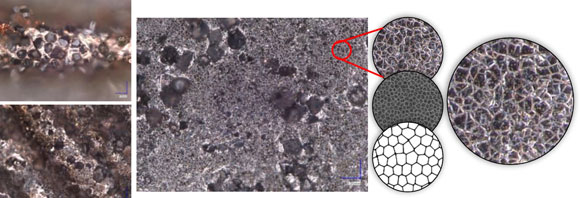
PBF-LB Additive Manufacturing of copper-coated diamond showing conduction-mode processing, defect regimes and the formation of sub-micron porous architectures (Courtesy https://doi.org/10.1016/j.diamond.2026.113591)

Multi-track experiments revealed six distinct processing regimes, ranging from incomplete melting to fully fused structures and vapour-driven porosity. In particular, the team identified a previously unreported self-organised sub-micron porous lattice forming within a narrow 113–141 J/mm³ energy window. This structure consisted of polygonal networks with pore sizes of 0.5–2 μm and ligament thicknesses of 0.2–0.8 μm, generated through capillary-driven breakup of thin molten copper films between overlapping tracks.

To explain this phenomenon, the researchers developed the Robinson–Arjunan scaling law, combining classical thin-film instability theory with PBF-LB-specific conditions. The model is intended to accurately predict the characteristic spacing of the observed lattice structures, supporting the experimental findings.
Article: Inside Nikon’s metal AM strategy
Part 2: Scaling industrial production in Long Beach
Read now

The study concluded that the PBF-LB Additive Manufacturing of copper-coated diamond is not solely a consolidation process, but also a mechanism for controlled microstructural self-organisation. By tailoring energy input and feedstock design, the process enables the formation of hierarchical porosity and sub-micron architectures not achievable in monolithic metals, opening new opportunities in the Additive Manufacturing of metal–ceramic composites.

‘Process driven self-organisation in laser powder bed fusion of copper coated diamond’ is available here.
www.wlv.ac.uk

www.diamondhardsurfaces.com

www.pmu.edu.sa

GET THIS ISSUE:  PDF  |  VIEW ONLINE  |  BUYER’S GUIDE
MaterialsNewsResearch
April 23, 2026

TRUSTED CONTENT. TARGETED AUDIENCE

Advertise with Metal AM and access a global base of 50,000+ AM professionals.

Contact Jon Craxford: [email protected]

Request a Media Pack
  • AM machines
  • Process monitoring & calibration
  • Heat treatment & sintering
  • HIP systems & services
  • Pre- & post-processing technology
  • Powders, powder production and analysis
  • Part manufacturers
  • Consulting, training & market data

Don’t miss a thing – register for our newsletter

Don't miss any new issue of Metal AM magazine, and get the latest industry news. Sign up to our twice weekly newsletter.

Register now

Join 40,000+ other AM professionals – follow us online

About Metal Additive Manufacturing magazine

Metal AM magazine, published quarterly in digital and print formats, is read by a rapidly expanding international audience.

Our audience includes component manufacturers, end-users, materials and equipment suppliers, analysts, researchers and more.

In addition to providing extensive industry news coverage, Metal AM magazine is known for exclusive, in-depth articles and technical reports.

Our focus is the entire metal AM process from design to application.

Each issue is available as an easy-to-navigate digital edition and a high-quality print publication.

Discover our magazine archive…

The free to access Metal Additive Manufacturing magazine archive offers unparalleled insight into the world of metal Additive Manufacturing from a commercial and technological perspective through:

  • Reports on visits to leading metal AM part manufacturers and industry suppliers
  • Articles on technology and application trends
  • Information on materials developments
  • Reviews of key technical presentations from the international conference circuit
  • International industry news

All past issues are available to download as free PDFs or view in your browser.

Browse the archive

Share via
Copy link
Powered by Social Snap