Study explores laser DED Additive Manufacturing for WC-Co carbides

Japanese researchers from Hiroshima University and Mitsubishi Materials Hardmetal Corporation have published research in the International Journal of Refractory Metals and Hard Materials focused on the use of laser-based Directed Energy Deposition (DED) Additive Manufacturing to produce WC-Co cemented carbides at reduced waste and cost compared to traditional manufacturing methods.
One fabrication method used in this study involves direct irradiation on top of the cemented carbide rod, with the rod positioned ahead of the deposition direction. In the second method, the laser leads the process, irradiating the region between the base material (iron) and the bottom of the cemented carbide rod. In both methods, the metals are softened instead of completely melted to form the cemented carbide.
“Cemented carbides are extremely hard materials used for cutting tool edges and similar applications, but they are made from very expensive raw materials such as tungsten and cobalt, making reduction of material usage highly desirable. By using additive manufacturing, cemented carbide can be deposited only where it is needed, thereby reducing material consumption,” stated corresponding author Keita Marumoto, Assistant Professor at Hiroshima University’s Graduate School of Advanced Science and Engineering.
Defect-free, industrial-grade carbides achieved
According to the study, results demonstrated this method to be effective in maintaining the hardness and mechanical integrity of conventionally manufactured WC-Co cemented carbides, achieving a base material with hardness of over 1400 HV (a unit representing resistance to penetration), without introducing any defects or decomposition. Materials at this hardness level rank among the hardest used in industry. Producing the cemented carbide molds without defects does appear possible, which is the main goal of this study, though results were said to have varied.
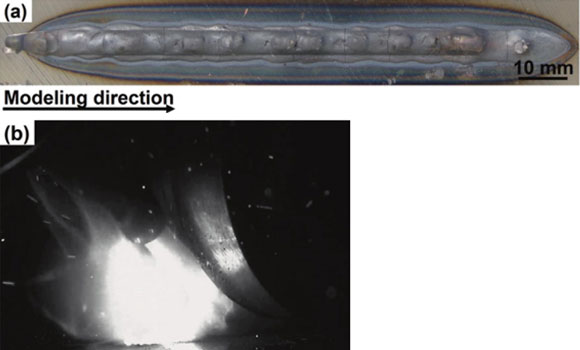
As an example, the study noted that the rod-leading method seemed to result in the decomposition of WC on the upper part of the build, leading to defects in the final product. The laser leading method also had issues maintaining the hardness necessary for success. A nickel alloy-based middle layer was added, and that, along with maintenance and monitoring of temperatures (above the melting point for cobalt, below the temperature of grain growth) led to a cemented carbide produced via Additive Manufacturing without sacrificing hardness.
The results are a foundation for further improvements, expanding research to manage the issue of cracking, and create more complex shapes.
“The approach of forming metal materials by softening them rather than fully melting them is novel, and it has the potential to be applied not only to cemented carbides, which were the focus of this study, but also to other materials,” Marumoto explained.
The research team expects further work to be carried out on the fabrication of cutting tools, the use of other materials and investigations of durability.
‘Effect of the hot-wire laser irradiation method and a Ni-based alloy middle layer on mechanical properties and microstructure in additive manufacturing of WC–Co cemented carbide’ is available here.