One Click Metal enables patient-specific implants at Lerdsin Hospital

One Click Metal, located in Tamm, Germany, has published a case study on the use of its Additive Manufacturing technology in the clinical workflow at Lerdsin Hospital, a public teaching hospital in Bangkok, Thailand. In particular, the study demonstrates the use of metal AM in surgically treating severe bone deformities.
Lerdsin’s orthopaedics department, active since 1957, functions as an accredited training centre, explains One Click Metal. The adoption of Additive Manufacturing is said to reflect the hospital’s broader vision of making personalised orthopaedic treatment accessible to more patients across Thailand.
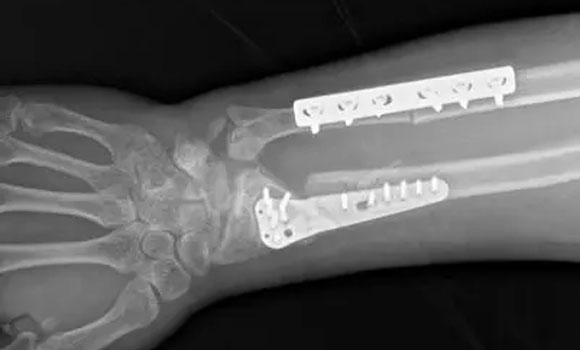
The case
One orthopaedic patient presented at Lerdsin with a severe bone malunion, where a fracture had healed in an incorrect position. The patient’s bone geometry was highly irregular, making reconstruction a challenge.
According to One Click Metal, standard market-ready titanium locking plates could not conform to the patient’s bone surface and would have left gaps between the component and bone. This may have resulted in compromised stability and significantly increased risk of implant failure.
In addition to the complex anatomy, the surgical team faced required:
- Maximum surface contact between implant and bone
- Proven biocompatibility for long-term implantation
- High mechanical strength to withstand daily loads
- Precisely defined screw hole orientation for accurate fixation
Meeting all these conditions necessitated the use of a customised solution rather than a standard plate.
On-site Additive Manufacturing
To create the bespoke component, Lerdsin used its on-site metal Laser Beam Powder Bed Fusion (PBF-LB) Additive Manufacturing machine with 200 W fibre lasers from One Click Metal.
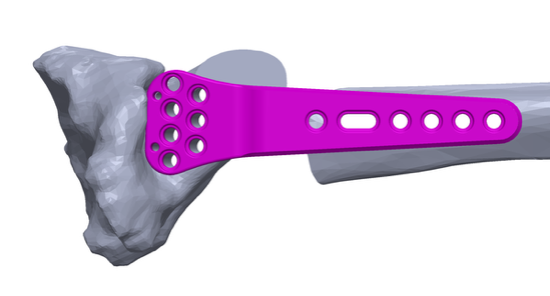
The process began with creating a high-resolution 3D model of the patient’s bone from medical imaging data. Based on this model, the surgical team designed customised cutting and reduction guides using Materialise software, allowing the operation to be precisely planned and executed.
Once the bone was repositioned, its anatomy changed significantly in both alignment and rotation. A conventional implant would no longer fit. To solve this, a fully customised titanium implant plate was designed and additively manufactured to match the post-reduction bone geometry exactly.
The component was additively manufactured with a layer height of 20 µm over the course of 1 hr 36 min. According to the hospital, the manufacturing cost was equivalent to approximately €49.
According to One Click Metal, the success of the case was driven by close collaboration between surgeons and engineers. Dr Navapong Anantavorasakul, MD, an orthopaedic surgeon specialised in hand and microsurgery, guided the clinical strategy and defined surgical requirements. Biomedical engineer Napakarn Thussakorn translated clinical needs, converting CT scans into models and designing the guides, instruments and implants.
The use of metal Additive Manufacturing reportedly enabled several key benefits: increased surgical precision through implants and guides tailored to the patient’s anatomy, pre-defined steps for the operation, shorter operation times (reducing anaesthesia risks and improving efficiency), reduced overall treatment costs, full customisation, and faster clinical response, with the initial bone scan, component design and manufacturing reportedly completed in days.