Comet launches Dragonfly 3D World 2025 with smart AI tools fast visualisation
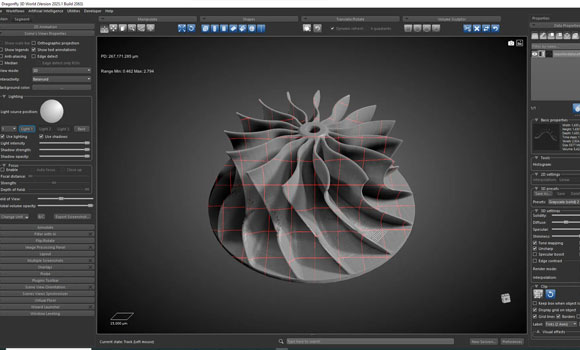
Comet Technologies Canada Inc, located in Montreal, has announced the launch of Dragonfly 3D World 2025, a software upgrade that features new, high-precision surface determination, faster GPU-accelerated performance, one-click AI segmentation, and next-generation visualisation tools.

The newly integrated Meta AI’s Segment Anything Model (SAM) enables one-click annotation for complex objects, from microstructures to biological tissues. By adapting across imaging modalities, Comet stated that SAM enables users to identify and isolate features instantly, without manual thresholding or model training.
“This release marks a major leap forward in segmentation automation,” says Joscha Malin, Director of Software Solutions at Comet. “Dragonfly 2025 helps our users spend less time preparing data and more time interpreting it, driving faster decisions and more accurate results.”
3D World 2025’s redesigned Surface Determination engine is capable of sub-voxel precision, which enables highly accurate surface and mesh extractions. These are identified as a critical step for geometric metrology, roughness analysis, and dimensional validation. When used with new 3D rendering modes, users can visualise internal and external structures with photorealistic clarity.

The update also features GPU-accelerated filtering, denoising, and skeletonisation that reportedly deliver a performance improvement of as much as 100 x over CPU processing. Comet noted the following example: a Canny filter applied to a 1024³ USHORT dataset was completed in under 1.4 seconds on an NVIDIA GeForce RTX 4090, compared to over 55 seconds on an Intel i7-13700K CPU.
Together with macro automation and upcoming Auto Executor add-ins, this release is designed to allow users to build reproducible, high-throughput pipelines that are scalable from single-lab experiments to industrial inspection lines. More broadly, the company anticipates that the Dragonfly update will help research teams and manufacturers achieve faster validation cycles, improved quality control, and a data-driven understanding of materials and components.