Argonne studies heat-treated AM steels for nuclear use
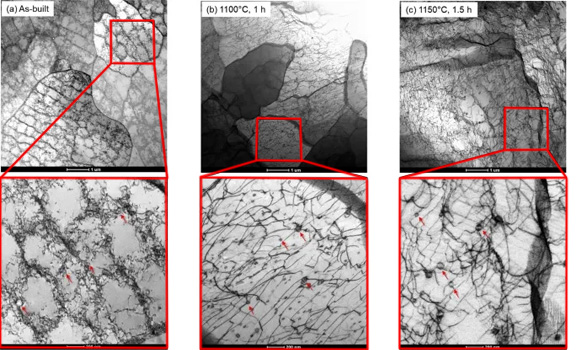
In two recent studies, researchers at the US Department of Energy (DoE)’s Argonne National Laboratory used X-ray diffraction and electron microscopy to investigate steels (316H and Alloy 709) made via Laser Beam Powder Bed Fusion (PBF-LB) Additive Manufacturing and their differences from wrought steels, including the impact of heat treatments.
Both tested steels are used in the nuclear industry, with 316H, an established stainless steel for the structural components of nuclear reactors, and A709, designed for advanced reactor applications. However, before these additively manufactured materials can be trusted in stringent reactor environments, the nuclear industry needs a deeper understanding of the materials and how to control them.
“Our results will inform the development of tailored heat treatments for additively manufactured steels,” stated Srinivas Aditya Mantri, Argonne materials scientist and a co-author on both studies. “They also provide foundational knowledge of printed steels that will help guide the design of next-generation nuclear reactor components.”
Heat treating AM steel
The rapid heating and cooling that steel undergoes during PBF-LB Additive Manufacturing causes unique features in the material’s microstructure. For example, additively manufactured steels show a higher number of dislocations – defects where an otherwise consistent pattern in the material’s structure suddenly shifts. While these strengthen the steel, they also increase internal stress and leave it more vulnerable to fracture.
Heat treatment is one way to relieve this stress. During this process, the material begins to heal through a process called ‘recovery’, wherein high temperatures allow atoms to shift and repair dislocations. This, in turn, can lead to recrystallisation, where new, strain-free grains replace the original structure altogether. However, keeping some dislocations can be beneficial as they promote the precipitation of particles that, in the right quantities, can further improve a material’s performance.
The Argonne researchers studied the delicate balance between these processes in additively manufactured steels, paving the way toward their adoption in nuclear applications.
316H
In one of the studies, the researchers compared the microstructures of wrought and PBF-LB samples of 316H using capabilities at Argonne’s Center for Nanoscale Materials (CNM), a DOE Office of Science user facility, including scanning electron microscopy (SEM) and scanning transmission electron microscopy.
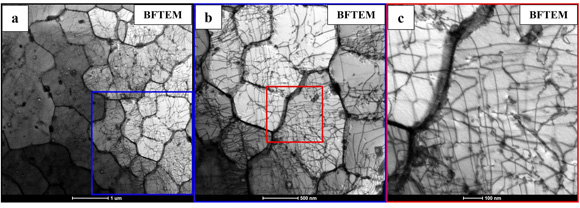
They also performed in situ X-ray diffraction experiments at a second DOE Office of Science user facility at Argonne, the Advanced Photon Source (APS). At beamline 1-ID, the team probed the samples with high-energy X-rays as they underwent variations of a heat treatment called solution annealing.
“The high flux of photons provided by the APS allowed us to track the evolution of the microstructures in real time during the dislocation recovery process,” said Xuan Zhang, another materials scientist at Argonne and co-author on both studies. “That’s something you can only achieve with a synchotron X-ray facility like the APS.”
The experiments reported that recovery and recrystallisation were inhibited by nano oxide, nanoscale defects common in additively manufactured materials.
“Nano oxides act as a sort of barrier to the movement of dislocations and the growth of new grains, causing some dramatic differences between the response of [PBF-LB]-printed and wrought steels to heat treatment,” Zhang said. “For example, the printed samples started to recrystallise at temperatures several hundred degrees higher than their wrought counterparts.”
The researchers took the detailed structural data obtained at the CNM and APS and related it to mechanical properties, including strength under tension and resistance to creep. A major consideration for the nuclear industry, creep is the slow deformation of a material under a constant mechanical load.
A709
The other study focused on A709, a newer, more advanced stainless steel designed for high-temperature environments like those inside sodium fast reactors – next-generation reactor systems that operate at higher efficiencies. In this study, Argonne researchers investigated samples of A709 additively manufactured via Laser Beam Powder Bed Fusion, reportedly marking the first experimental look at an AM form of the alloy.
The researchers used CNM’s capabilities (including SEM and transmission electron microscopy) to inspect the samples of additively manufactured and wrought A709 internally during multiple heat treatments. The team also studied the strengths of the heat-treated samples under tension.
At both room temperature and 550ºC – a temperature relevant to sodium fast reactor applications – the AM A709 was said to have displayed higher tensile strengths compared to the wrought A709. This was likely because the AM samples began with more dislocations, which also promoted the formation of more precipitates during heat treatment, the authors stated.
“Our research is providing practical recommendations for how to treat these alloys,” said Zhang, “but I believe our biggest contribution is a greater fundamental understanding of printed steels.”