ETH students develop rotary PBF-LB for multi-metal Additive Manufacturing
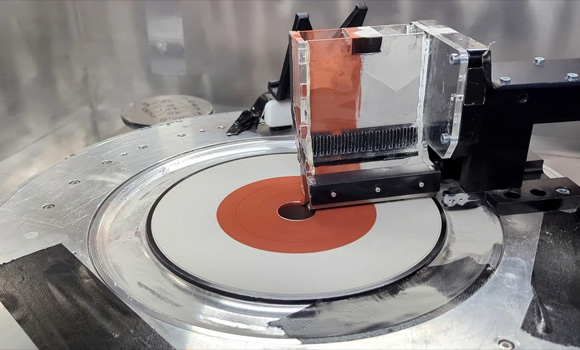
Students from ETH Zurich, Switzerland, have built a high-speed multi-material metal Laser Beam Powder Bed Fusion (PBF-LB) Additive Manufacturing machine that rotates the powder deposition and gas flow nozzles while it builds, enabling simultaneous processing of multiple metals without downtime. It is believed that the machine could fundamentally change the Additive Manufacturing of metal parts, resulting in significant reductions in production time and cost.
The team of six bachelor’s students developed the new machine in the Advanced Manufacturing Lab under the guidance of ETH Professor Markus Bambach and Senior Scientist Michael Tucker as part of the Focus Project RAPTURE. The students developed, constructed and tested the machine in just nine months. The machine is aimed at approximately cylindrical geometries in aerospace applications, such as rocket nozzles and turbomachinery, but is reportedly also of broad interest for mechanical engineering.
Project lead Tucker shared that the project came about from a very specific challenge: developing bi-liquid-fuelled rocket nozzles for ARIS, the Swiss Academic Space Initiative, which is building its own rockets with visions of reaching into space. Within the next few years, ARIS aims to reach the Kármán Line – the internationally recognised boundary of space set at an altitude of 100 kilometres, beyond which the atmosphere is too thin to support flight by aircraft without special propulsion.
In order to withstand the intense heat and pressure over an extended launch, rocket nozzles should ideally be made of multiple metals. For example, their interior can be made of heat-conducting copper with integrated cooling channels and their exterior of a heat-resistant nickel alloy.
“For small players like our student rocket team, this sort of multi-material technology has up to now been too complex and too expensive, putting it out of reach,” shared Tucker.
Rotational Additive Manufacturing
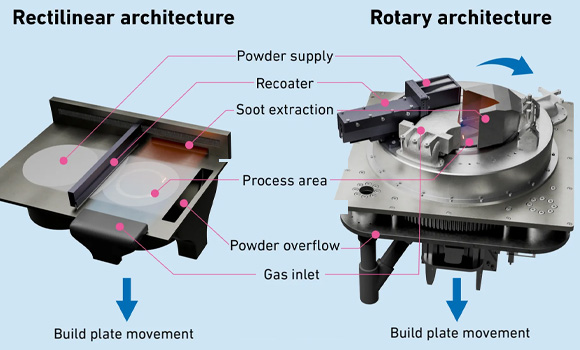
The heart of the new machine is a rotating platform that enables a high-speed manufacturing process. Unlike conventional rectilinear PBF-LB machines, where a new layer of powder must be applied after each layer is melted, the RAPTURE machine works continually due to its rotating platform. This means that powder is applied and fused by the laser simultaneously, which significantly enhances productivity. This reduces the manufacturing time for cylindrical components by more than two-thirds.
“This process is ideally suited to rocket nozzles, rotating engines and many other components in the aerospace industry,” Tucker added. “They typically have a large diameter but very thin walls,” he adds.
While the machine is also capable of producing non-axisymmetric or even arrays of parts, the rotating method is particularly effective for producing precisely this geometry.
Additively manufacturing two metals simultaneously
The rotating machine can process two different metals in a single operation. Conventional systems require several steps and a much greater quantity of metal powder. As the separation and recovery of mixed powder remains an open challenge, much of this powder becomes waste. The new method only deposits the material where it is needed within the component, thereby reducing waste.
The machine features a mechanism that blows inert gas over the area where the powder is fused. This prevents the component from oxidising while it is being manufactured. By-products such as soot and spatter are systematically removed via an outlet.
“At first we underestimated the extent to which the gas flow mechanism affects product quality,” said Tucker. “Now we know it’s crucial.”
Due to the rotating architecture of the newly developed machine, the local gas flow conditions can be controlled much more tightly than with a conventional machine.
Customised components
The students faced a number of technical challenges when developing the novel PBF-LB machines, one of which involved the synchronisation of the scanning laser with the rotation of the gas inlet and powder supply. In addition, as many of the parts needed for the machine are not commercially available, the team designed their own. These include a rotatable connection for the gas inlet and a system that automatically refills the powder during operation.
Nonetheless, the student team managed to build a machine that reportedly looks almost ready for industrial application.
“The fact that a team of students developed and built a functioning machine in nine months is pretty remarkable,” Tucker concluded.
Potential for aerospace, e-mobility and other sectors
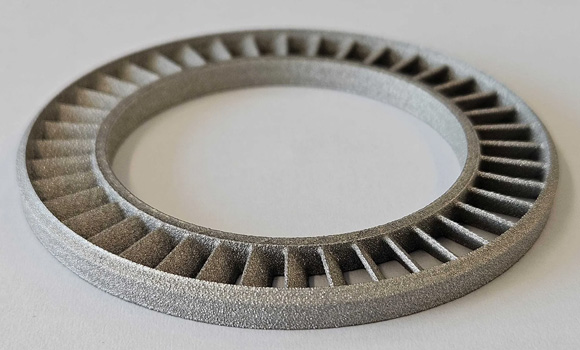
In addition to concrete applications for ARIS and the aerospace industry in general, the team reportedly sees potential applications in other sectors, such as aircraft, gas turbines and electric motors, where ring-shaped geometries are the norm. ETH has filed a patent application covering the rotary multi-material Laser Beam Powder Bed Fusion technology, which has since been nominated for the ETH Spark Award.
The components manufactured with the prototype so far have a diameter of up to 20 centimetres. The research team is now looking at scaling the process to higher speeds and larger diameters, and they are currently looking for industry partners to collaborate with them to develop and deploy this technology further.
The full article ‘Design and analyses of powder deposition, gas flow, and productivity for a rotary laser powder bed fusion system’ is available here.