British cyclists set world records aided by Renishaw’s metal Additive Manufacturing
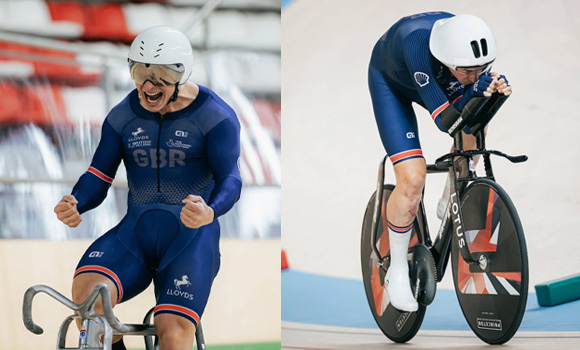
British Cycling’s Matt Richardson and Will Bjergfelt have set new world records at the Konya Velodrome in Türkiye, using track bikes featuring integral metal Additive Manufacturing components from Renishaw, based in Wotton-under-Edge, Gloucestershire, UK.

With a time of 8.941 seconds, Matt Richardson became the first man with a time under 9 seconds over the 200m sprint.
“I did it, I came here to do that [go sub-9 seconds] and that’s what I did so, it’s a pretty cool feeling to accomplish the one thing that I came out here to do. A bit of relief there,” Richardson stated. “It was a lot faster [than I’ve previously ridden], I was basically just a passenger. I gave the bike a bit of direction and it was just steering itself almost. I rode a lot of it outside the sprint lane, so I know there’s a bit more there.”

Will Bjergfelt set a new world record of 51.471 km in the Men’s C5 UCI Hour Record. In doing so, he also became the first para-cyclist to break the 50 km barrier.
Within the first fifteen minutes of the ride, Bjergfelt had covered almost 13 km, with an average speed of 50-51 km per hour, a pace he managed to hold onto for the entirety of the hour. With four minutes to go, Bjergfelt broke the existing record of 47.569 km, allowing him to stretch his 50 km goal to the 51.471 km he achieved, beating the previous record by almost 4 km.
“[I feel] amazing, it’s not quite sunk in yet really. Whilst I was going round the track and everyone was cheering at the end there, it started to hit home. I don’t think it’s quite hit home yet that I’ve smashed the world record on the track and that’s a dream come true,” Bjergfelt stated. “Coming here with the best equipment; the Hope/Lotus bike, the Renishaw bars, everything else that’s been afforded to me, the Ale custom skin suit, the support that we’ve had from Shell, [the Great Britain Cycling Team], my employers GKN Aerospace where I’ve worked for the past twenty-five years, this is something that means so much to me.”
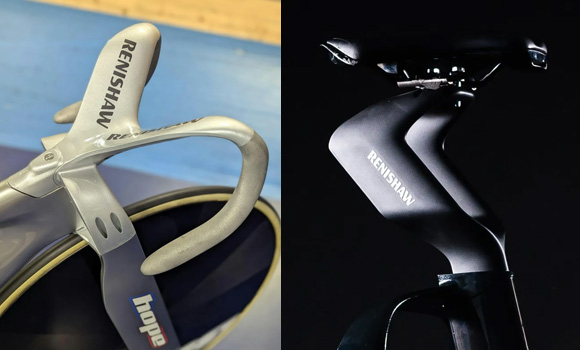
Renishaw’s metal Additive Manufacturing
Renishaw has partnered with British Cycling for several years, contributing to the success of the team and its athletes at major events.
Ahead of the 2024 Olympics, the partnership resulted in an aerodynamic seat post, featuring a hollow centre and backwards-leaning design. This allows airflow through the centre of the bike. Additive Manufacturing also facilitated the rapid production of unique titanium seat posts to the exact measurements of the individual riders.
The company also produced cranks for the bikes, with a 50 mm shaft and an internal lattice structure. This helps the component withstand up to 350 kg of force on the arm.
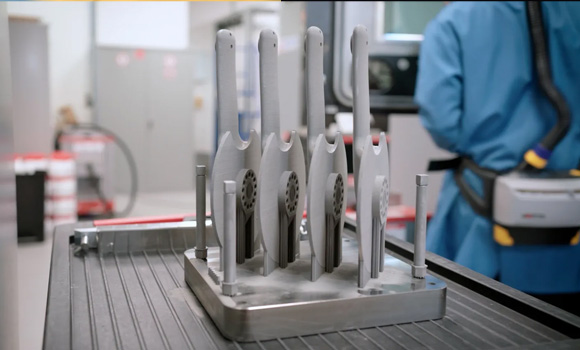
Oliver Caddy, British Cycling’s lead project engineer, worked closely with Matt Richardson to design the additively manufactured Ti handlebars. “3D printing is just wizardry because you don’t have to make a tool or wait for something to come back from China. If we agree on a design with Renishaw, within a week I’ve got something that’s rideable on the track,” Caddy told Bike Radar. “It’s revolutionised the way we get people comfortable and fast on bikes.”