Researchers fine-tune damping properties of NiTi alloy via powder bed fusion
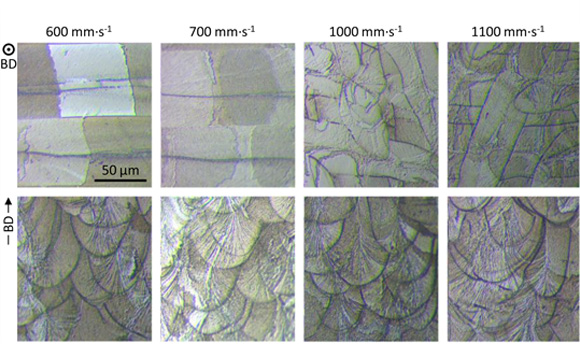
OM images of samples fabricated at P = 90 W with different V (Courtesy S Zhong et al, ‘Achieving efficient damping performance tuning in NiTi alloy via laser powder bed fusion’, Acta Materialia vol 296)

Researchers from the City University of Hong Kong and Huazhong University of Science and Technology, and mainland Chinese organisations Chongqing University and Shenyang National Laboratory for Materials Science have published a scientific paper in Acta Materialia focused on fine-tuning the damping properties of NiTi when processed via Laser Beam Powder Bed Fusion (PBF-LB) Additive Manufacturing.
NiTi alloys exhibit an impressive damping effect at the damping peak temperature (Tp), and aligning Tp with target temperatures may present significant value. Traditionally, tuning the damping performance of NiTi alloys demands precise modifications to raw material composition and complex thermomechanical processing. ‘Achieving efficient damping performance tuning in NiTi alloy via laser powder bed fusion’ reported achieving an efficient tuning of Tp across a broad 93 K range via PBF-LB, thus eliminating the need for material modifications and further treatments.
Article: Inside Nikon’s metal AM strategy
Part 2: Scaling industrial production in Long Beach
Read now

Additionally, the study discussed the composition and influencing factors of damping peaks in PBF-LB NiTi alloys. Furthermore, high-damping, lightweight NiTi porous structures were fabricated by PBF-LB, highlighting advantages over conventional routines.

Adjusting the laser scanning speed during PBF-LB Additive Manufacturing modulated the laser–powder interaction, resulting in variations in temperature, lifespan, and volume of the molten pool. Through the use of this AM technology, researchers tuned the damping peak temperature of NiTi alloys from 345/278 to 300/230 K while maintaining a high damping peak intensity (Q−1) between 0.06 and 0.11. The tuning of Tp was attributed to changes in Ni content due to element evaporation, which was achieved by adjusting the laser scanning speed (V). Specifically, increasing V alleviated laser–powder interactions, leading to lower molten pool temperature, lifespan, and volume.

‘Achieving efficient damping performance tuning in NiTi alloy via laser powder bed fusion’ is available here.
www.cityu.edu.hk

www.hkust.edu.hk

english.cqu.edu.cn

english.synl.ac.cn

GET THIS ISSUE:  PDF  |  VIEW ONLINE  |  BUYER’S GUIDE

TRUSTED CONTENT. TARGETED AUDIENCE

Advertise with Metal AM and access a global base of 50,000+ AM professionals.

Contact Jon Craxford: [email protected]

Request a Media Pack
  • AM machines
  • Process monitoring & calibration
  • Heat treatment & sintering
  • HIP systems & services
  • Pre- & post-processing technology
  • Powders, powder production and analysis
  • Part manufacturers
  • Consulting, training & market data

Don’t miss a thing – register for our newsletter

Don't miss any new issue of Metal AM magazine, and get the latest industry news. Sign up to our twice weekly newsletter.

Register now

Join 40,000+ other AM professionals – follow us online

About Metal Additive Manufacturing magazine

Metal AM magazine, published quarterly in digital and print formats, is read by a rapidly expanding international audience.

Our audience includes component manufacturers, end-users, materials and equipment suppliers, analysts, researchers and more.

In addition to providing extensive industry news coverage, Metal AM magazine is known for exclusive, in-depth articles and technical reports.

Our focus is the entire metal AM process from design to application.

Each issue is available as an easy-to-navigate digital edition and a high-quality print publication.

Discover our magazine archive…

The free to access Metal Additive Manufacturing magazine archive offers unparalleled insight into the world of metal Additive Manufacturing from a commercial and technological perspective through:

  • Reports on visits to leading metal AM part manufacturers and industry suppliers
  • Articles on technology and application trends
  • Information on materials developments
  • Reviews of key technical presentations from the international conference circuit
  • International industry news

All past issues are available to download as free PDFs or view in your browser.

Browse the archive

Share via
Copy link
Powered by Social Snap