UK-US fusion agreements highlight growing role for advanced manufacturing
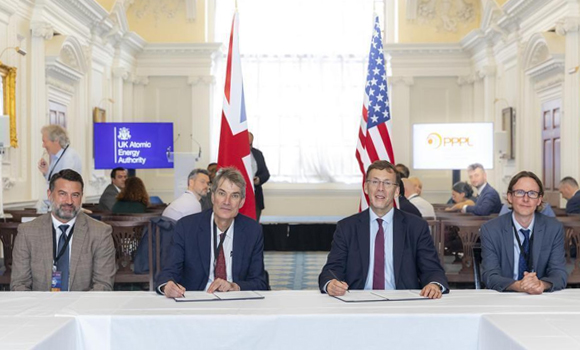
The UK and US announced new agreements covering fusion research, supercomputing and regulatory cooperation at the Global Fusion Policy Summit, held at Mansion House in London on September 14, 2026. The developments come as fusion programmes increasingly draw on powder-based manufacturing technologies. UK fusion programmes are exploring Additive Manufacturing of tungsten components and Hot Isostatic Pressing (HIP) to produce complex, multi-material parts using tungsten, copper alloys and fusion-grade steels.
The UK Atomic Energy Authority (UKAEA) and the US Department of Energy’s Princeton Plasma Physics Laboratory (PPPL) signed a Joint Declaration of Intent to explore linking UKAEA’s SUNRISE AI supercomputer with PPPL’s STELLAR-AI platform. The proposed SUNRISE–STELLAR-AI Federation will investigate how the two systems could be used together to support fusion research, including development of digital twins and the movement of computing workloads between the platforms.

The agreement follows wider UK investment in fusion research infrastructure. The government is investing £125 million in an AI Growth Zone at Culham, including £45 million for the SUNRISE supercomputer, as part of more than £2.5 billion in government funding for fusion energy over five years. The UK Department for Energy Security and Net Zero and US Department of Energy also issued a Joint Statement setting out priorities for international cooperation on fusion energy, including regulatory harmonisation, standards, public-private collaboration, insurance and AI.
The UK has also published its Fusion regulation landscape, setting out the regulatory processes for developing and operating fusion facilities, while the Environment Agency and Health and Safety Executive have introduced an early engagement process for developers.
Alongside the policy announcements, the University of Birmingham, Electric Power Research Institute and industry partners announced a £2.63 million collaboration through the Fusion Reactor Shielding Materials (FURESHMA) programme. Kyoto Fusioneering also announced plans to invest up to £3 million in the UK through Project ALBION, supporting development and testing of materials for the government-backed Spherical Tokamak for Energy Production (STEP) programme.
STEP aims to deliver a prototype fusion power plant at West Burton in Nottinghamshire by 2040. The summit also coincided with publication of the UK Fusion Investment Prospectus, intended to help companies and investors understand opportunities in the UK fusion sector.