ToffeeX software improves Nissan oil cooler performance
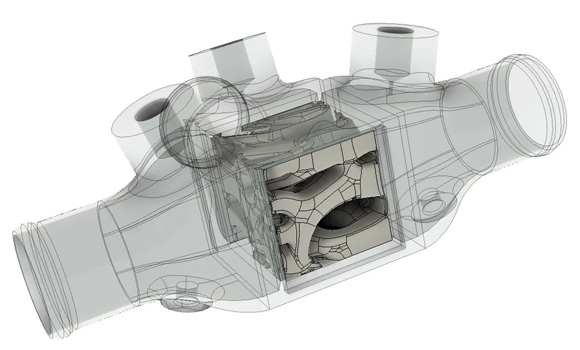
ToffeeX, based in London, UK, has reported using its physics-driven generative design software to design and optimise a cross-flow oil cooler for Japanese automobile manufacturer Nissan.

As part of the project, ToffeeX leveraged its Two-Fluid Optimisation feature to design the internal heat exchanger’s core, simultaneously optimising two different fluids to maximise heat transfer between them while minimising pressure drops.
The initial design domain consisted of a cubic volume, later expanded to incorporate extended inlet and outlet regions. These regions, defined as ‘non-designable’ in ToffeeX, are intended to improve accuracy and stability.
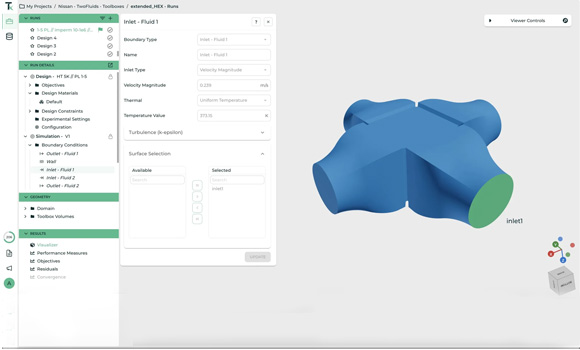
As part of the design activity in ToffeeX software, the company explored a range of solutions by varying the weightings of the optimisation objectives to identify the combinations of parameters that produced a satisfactory performance. Further optimisations were then conducted with a Minimum Wall Thickness constraint to satisfy manufacturing requirements.
Results
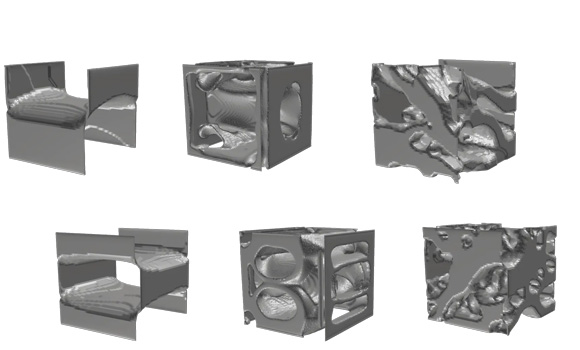
Nissan performed CFD simulations using STAR-CCM+, comparing the performance of all designs, including those optimised using the ToffeeX software. This featured a benchmark design with a gyroid infill pattern and a characteristic size of 4.6 mm.

According to ToffeeX, the final design was approximately 15x more effective in terms of heat transfer-to-pressure drop ratio compared to both the reference gyroid and plated heat exchanger designs. Moreover, the software was able to design for Additive Manufacturing and achieve minimum wall thickness constraints.
While the ToffeeX designs did not achieve the same total heat transfer as the gyroid, they achieved superior heat transfer-to-pressure drop ratios compared to conventional solutions.