Strengthening of historical buildings using DED and 3D scanning
Researchers from the University of Cyprus’ Department of Civil and Environmental Engineering, based in Nicosia, have created a method for strengthening the walls of historical buildings using Wire Arc Directed Energy Deposition (DED) and 3D laser scanning. The process was developed for buildings with unreinforced masonry, particularly those in areas prone to earthquakes.

Historic buildings are notoriously vulnerable to earthquakes due to the absence of reinforcement and the brittle nature of traditional mortars. Conventional strengthening methods, such as shotcrete, fibre-reinforced polymers (FRP) or external steel ties, often conflict with conservation principles by altering the appearance or material compatibility of heritage façades.
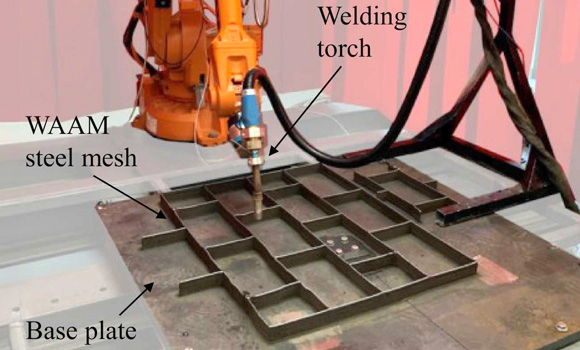
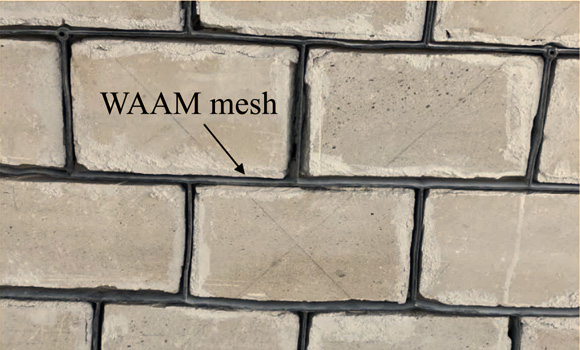
The new method leverages the design freedom of Additive Manufacturing to produce custom-fit steel reinforcing meshes that trace the exact geometry of a wall’s mortar joints, mapped through high-resolution 3D laser scanning. The meshes are inserted into shallow grooves cut along the mortar joints and then concealed through repointing, restoring the wall’s original aesthetic.
Proof-of-concept
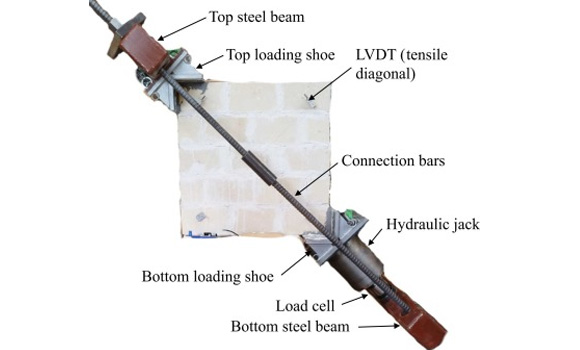
The researchers constructed wall panels, built using traditional techniques from local limestone with a natural lime-based mortar. While the proposed strengthening method is ultimately intended for application to various masonry types, including those with significant irregularities, a regular ashlar geometry was deliberately selected for these initial proof-of-concept tests.
Although in this study the mesh reinforcement was manufactured using carbon steel wire for cost-effectiveness, in practice, stainless steel wire, which can also be readily employed in DED, would be preferable to mitigate corrosion of the reinforcement in the long term, the researchers stated.

Two modified panels underwent testing and instrumentation similar to the benchmark (unmodified) versions. The results revealed a significant enhancement in the load-carrying capacity (in diagonal compression) of the modified panels.
The researchers noted that retrofitting the mesh reinforcement not only bolstered the strength and ductility, but also mitigated the variability in their performance. This reduction in variability was said to underscore the significant potential of the proposed strengthening technique in enhancing the consistency and predictability of the structural behaviour of masonry systems.
Towards practical implementation
While the proof-of-concept focused on regular ashlar masonry, future work will explore rubble and irregular stonework, modular on-site Additive Manufacturing, and stainless-steel wire for enhanced corrosion resistance. The researchers are also planning larger-scale validation and field trials on historic structures.
The full paper, ‘In-plane strengthening of heritage masonry structures using 3D-printed steel reinforcement: Experimental proof-of-concept,’ is available here.