Research investigates crystallisation during PBF-LB of Finemet alloys
New research into the crystallisation process of additively manufactured Finemet alloys could offer a promising roadmap toward optimising the production of soft-magnetic components produced via metallic glasses. The research was carried out by IMDEA Materials’ Sustainable Metallurgy research group led by Prof Teresa Pérez Prado, with additional contributions from Dr Biaobiao Yang and Dr Marcos Rodríguez Sánchez, in collaboration with colleagues from Saarland University, Rey Juan Carlos University and the Technical University of Berlin.
Metallic glasses, also known as amorphous metals, are valued for their mechanical strength, corrosion resistance and magnetic performance. Among them, Finemet alloys are particularly attractive for energy-related applications such as transformers, inductors and electric motors. However, their wider adoption has been limited by the difficulty of manufacturing bulk components with complex geometries while preserving their desirable amorphous or nanocrystalline structure.
Additive Manufacturing, and in particular Laser Beam Powder Bed Fusion (PBF-LB), offers a promising alternative in this regard to more traditional techniques. However, the extreme thermal conditions inherent to the PBF-LB process can induce crystallisation of Finemet’s iron-silicon (Fe-Si) microstructure.
This, in turn, plays a key role in the final component’s properties. The size, distribution and type of crystalline phases ultimately determine the material’s magnetic efficiency, electrical resistivity and mechanical behaviour. As such, a finely tuned nanocrystalline structure is crucial to enhancing the soft metal performance and enabling improved efficiency.
“Understanding these crystallisation mechanisms is crucial to the stability and performance of metallic glasses, and thus to expand their practical applications and integrate them into complex, high-performance systems,” explained IMDEA Materials’ Saumya Sadanand, the publication’s lead author.
The recent work, published in Additive Manufacturing and carried out as part of the Horizon Europe AM2SoftMag project, demonstrates how, by employing a double scanning strategy and varying the scan speed during the printing process, researchers were able to tailor thermal conditions during the AM process. They were also able to analyse their effect on the resulting microstructure.
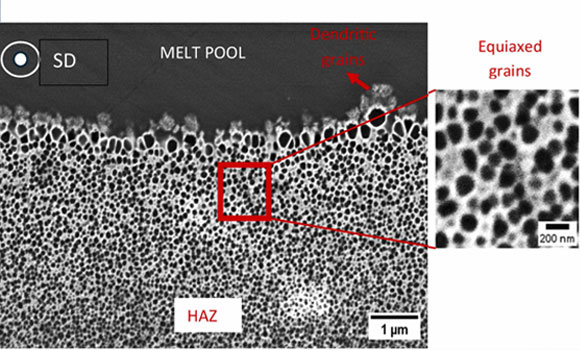
The crystallites formed during this process were revealed to be significantly larger and more heterogeneous than those obtained through conventional routes such as the annealing of melt-spun ribbons. The variation in their size, from a few tens to several hundred nanometres, was attributed to the highly localised and fluctuating thermal conditions inherent to the AM process.
Crystallisation during the PBF-LB process was demonstrated to take place either during rapid solidification of the melt pool under certain cooling conditions, or in the heat-affected zone (HAZ) during subsequent laser passes.
“What this work shows is that to manufacture a nanocrystalline-amorphous composite with a complex geometry using LPBF, and which is suitable to be used as a passive motor component, the selection of parameters should aim to lower cooling rates”, says Sadanand. “This serves to increase the nucleation rate, suppressing the formation of large grains and limiting the formation of nanocrystals to the HAZ.”
In addition, researchers identified the formation of a smaller population of dendritic crystals during solidification at the boundaries of the melt pool, with their size decreasing as cooling rates increase.
“Overall, these findings highlight the strong influence of thermal gradients and cooling dynamics on nucleation and growth mechanisms”, concluded Sadanand.
The full paper is available to read here.