Queen’s Propulsion Laboratory develops additively manufactured Kelvin Mk1 liquid rocket engine
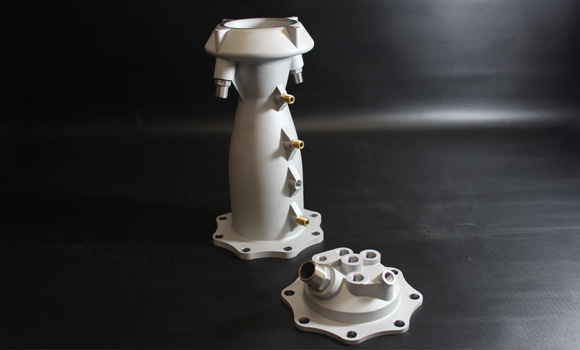
Students at Queen’s University Belfast have reached a major milestone for Northern Ireland’s space sector with the development of the Kelvin Mk1 liquid rocket engine. The project was Led by Queen’s Propulsion Laboratory (QPL) and is said to be the region’s first student-designed engine of its kind.
Laser Prototypes Europe (LPE) sponsored the project, additively manufacturing the engine’s combustion chamber and injector head, followed by heat-treatment and post-processing, at the company’s Belfast facility.
The chamber was produced via Laser Beam Powder Bed Fusion (PBF-LB) AM in AlSi10Mg aluminium, selected for its light weight and high thermal conductivity. The component features internal cooling channels and was built as a single piece, eliminating stress-prone welds and joints. Post-processing included full depowdering, heat treatment, and surface finishing to meet aerospace-grade standards.
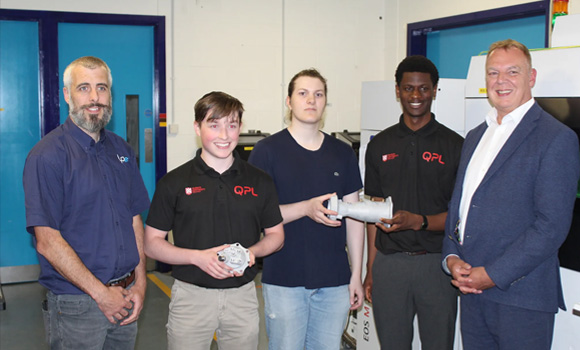
“Additive Manufacturing was the right solution for this engine, not just for its complexity, but because it enabled speed, precision, and performance in a single process,” explained Patrick Walls, Engineering Director at LPE. “We’re proud to support such an ambitious and capable team, and to contribute to a project that represents the next generation of propulsion technology coming out of Northern Ireland.”
Founded in 2023, QPL is Northern Ireland’s largest student rocketry team and gives students real-world experience in design, manufacturing, and testing of propulsion systems. Powered by isopropyl alcohol and nitrous oxide, the Kelvin Mk1 engine is scheduled for hot fire testing on July 10, 2025, at the Westcott Space Cluster, as part of the UK’s Race2Space competition.
The QPL team chose metal Additive Manufacturing for its design flexibility, speed, and part consolidation, critical factors that allowed more time for engine testing and integration. Working with LPE also gave the students valuable experience in designing for additive processes.
“Metal 3D printing gave us greater design freedom, faster manufacturing, and fewer parts,” said a QPL spokesperson. “LPE’s support throughout the project was invaluable, and the finished chamber exceeded our expectations.”
A full Q&A with the QPL team, covering their design approach and lessons learned from the manufacturing process, is available here.